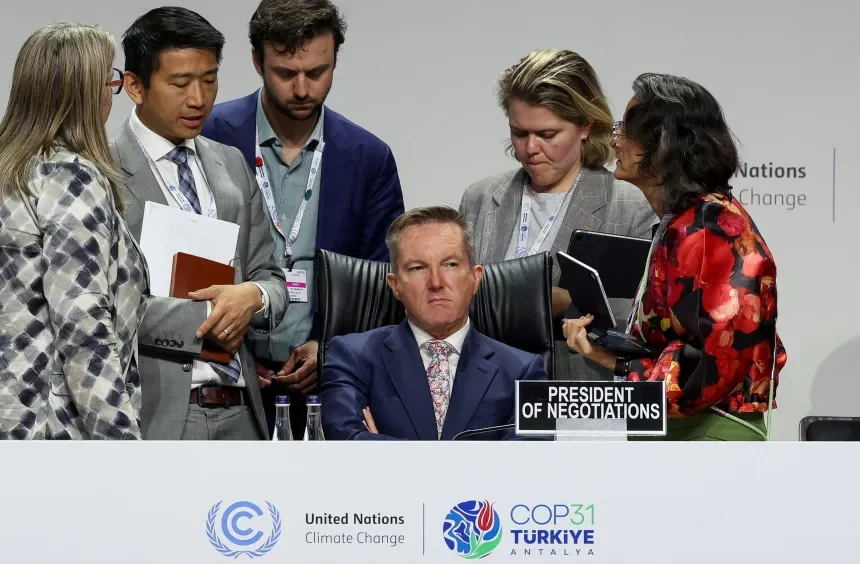
The COP31 climate summit in Antalya ended in a major breakdown on Sunday after more than two weeks of negotiations, as countries failed to reach consensus on a final agreement, largely over whether to include a commitment to move away from fossil fuels.
The collapse marked the first major breakdown of a UN climate summit since COP15 in Copenhagen in 2009. The talks also became the longest COP conference in history, extending well beyond their scheduled closing time.
Deep divisions emerged between countries pushing for stronger climate action and oil-producing nations opposing any explicit reference to fossil fuels. More than 100 countries supported retaining language on transitioning away from fossil fuels, but the wording was removed from successive drafts of the proposed Antalya Pact.
The European Union, Panama, Norway and the Marshall Islands were among those rejecting the final text. Ireland’s climate minister Darragh O’Brien said the EU would not support an agreement that did not even mention fossil fuels. He later accused some oil-producing countries of hijacking the negotiations.
Saudi Arabia and Russia were among the countries opposing references to fossil fuels. Russian delegate Sergei Kononuchenko argued that reducing oil and gas supplies faster than demand could trigger energy shortages, price shocks and greater reliance on more polluting fuels.
The disagreement came despite growing warnings about the climate crisis. A recent UN assessment projected that current policies could lead to global warming of around 2.8°C, far above the Paris Agreement’s 1.5°C target.
Climate finance was another major point of disagreement. Developing countries criticised the draft agreement for calling for efforts to at least triple adaptation finance by 2035 without establishing a baseline or specifying funding amounts.
The proposed text also faced criticism for promoting carbon capture technologies without a clear commitment to phase down fossil fuel production. Climate advocates warned that relying on carbon capture could distract from reducing emissions at their source.
COP31 President Murat Kurum acknowledged that there was no consensus on the proposed agreement. Meanwhile, negotiations president Chris Bowen described the outcome as deeply disappointing but highlighted a pledge signed by more than 90 countries to accelerate the electrification of their economies.
Despite the failure to secure an overarching agreement, countries are expected to continue climate negotiations ahead of the next summit in Ethiopia in 2027.
Climate advocates said the outcome reflected a serious failure of political leadership at a time when the world faces increasingly severe climate impacts. Former Irish president Mary Robinson criticised the lack of urgency, saying leaders had failed to respond adequately to the dangers of global warming.