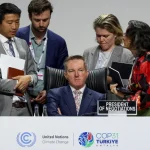
Australian Opposition Leader Angus Taylor has called for Climate Change and Energy Minister Chris Bowen to resign following the failure to secure an overarching political agreement at the COP31 climate summit in Antalya, Türkiye, where Bowen led the negotiations.
Speaking in Parliament on Monday, Prime Minister Anthony Albanese defended Australia’s decision to take on the negotiating role, saying it had been in the country’s national interest. However, he did not directly answer Taylor’s question about why Bowen should remain in the Cabinet.
COP31 ended on Sunday, two days beyond its scheduled closing date, without a comprehensive agreement due to disagreements over commitments to move away from fossil fuels and funding to help countries adapt to climate change.
However, governments adopted a separate decision on protecting workers and communities during the energy transition. Bowen also said more than 90 countries had signed a voluntary pledge to accelerate electrification.
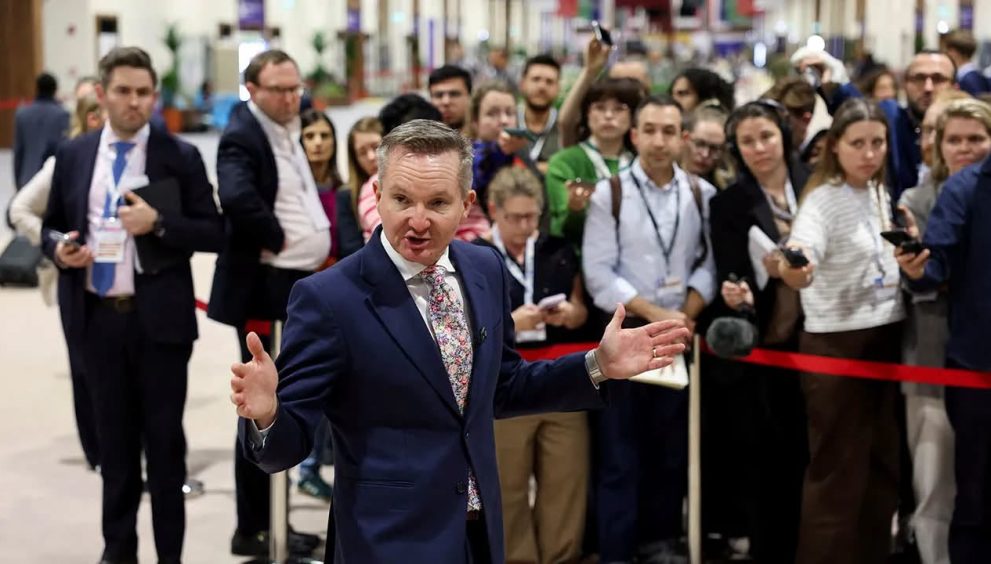
As the conference’s negotiating president, Bowen was responsible for helping secure an agreement acceptable to more than 190 participating countries. Turkish Environment Minister Murat Kurum served as COP31 president. Speaking to journalists after the talks, Bowen said positions on several issues had been so entrenched that reaching a compromise proved impossible.
Opposition Questions A$150 Million Spending
Calling for Bowen’s resignation, Taylor said he must take responsibility for the outcome of the negotiations.
In response, Albanese highlighted the concerns of Pacific island nations, saying climate change was their greatest challenge. Rising sea levels pose an existential threat to countries such as Tuvalu and Kiribati.
Opposition lawmakers also accused the government of wasting A$150 million on COP31-related activities. The federal budget allocated A$147.8 million over three years for preparations and related work, including A$34.6 million for preparatory meetings across the Pacific region.
The total amount Australia spent specifically on the Antalya summit has not yet been made clear.
Fiji Says Bowen Was Not Solely Responsible
Fiji had pushed for a clear commitment to move away from fossil fuels. At the closing session, the country’s Climate Minister Linda Tabuya acknowledged the time Bowen had devoted to negotiations and said Pacific representatives had seen that his door remained open throughout the process.
Addressing Bowen, she said: “This failure is not yours alone. It is the responsibility of all parties.”
Sohanur Rahman, executive coordinator of YouthNet Global, said climate-vulnerable countries could not afford another summit to end without agreement on fossil fuels and adaptation finance.
“By the time the next cyclone strikes, delays will mean death for coastal people waiting for shelters,” he said.
Rahman added that all participating governments shared responsibility for the outcome, while Bowen should also be held accountable for how he conducted negotiations.
“He must explain to people on the frontlines of the climate crisis exactly where the negotiations broke down and what Australia will now do to address the financing gap,” Rahman said.
Final Draft Drops References to Coal, Oil and Gas
At COP28 in Dubai in 2023, governments called for a transition away from fossil fuels in energy systems. Three years later, countries failed to agree on whether the main political agreement at COP31 should explicitly mention those fuels.
An early draft included a reference to fossil fuels, but the language was removed from a revised version published on November 19. The proposed Antalya Pact presented at the closing session also made no direct mention of coal, oil or gas.
The European Union said it could not support an agreement that failed to mention the main cause of global warming.
Panama’s lead negotiator, Ana Aguilar, said the draft weakened previous commitments and placed excessive reliance on carbon capture and storage technologies.
Russia opposed retaining references to fossil fuels, arguing that cutting supplies before demand falls could drive up prices and disproportionately affect poorer consumers.
Adaptation Finance Remains Unresolved
Countries had previously called for adaptation finance to be tripled to help developing nations respond to climate change. Developing countries wanted the agreement to specify how much funding would be available annually.
A draft published on November 16 proposed providing at least US$120 billion a year to developing countries for adaptation by 2035. However, the figure was removed from a revised draft three days later.
Questions Over Australia’s Own Climate Finance Commitments
Harjeet Singh of the Fill the Fund initiative and Julie-Anne Richards of the Make Big Polluters Pay coalition criticised Australia for failing to announce new financial commitments for climate-vulnerable countries despite leading the negotiations.
They said Australia made no new contribution to the international fund for addressing climate-related loss and damage.
Although Albanese and Bowen supported the Pacific Resilience Facility, which helps Pacific island countries prepare for disasters, Australia announced no additional funding for the initiative at COP31. The country had previously pledged A$100 million to the facility.
Singh and Richards pointed to Nepal as an example of the growing gap between climate-related losses and available international funding.
They estimated that Nepal needs US$5 billion to recover from damage caused by flooding along the Koshi River following a glacial collapse in the Himalayas.
However, as of July 31, countries had pledged approximately US$823 million to the international Loss and Damage Fund. In October, the fund’s board provisionally allocated US$21.6 million for Nepal. The country must still submit an application and secure approval to receive the money.
Singh and Richards called for fossil fuel companies to contribute towards post-disaster reconstruction costs, arguing that while these companies profit from selling coal, oil and gas, affected communities bear the costs of rebuilding homes and livelihoods.
A 2024 survey by the Australia Institute found that 69 per cent of respondents supported imposing a special tax on fossil fuel companies.
Pacific Island Nations Express Concern
Tuvalu hosted a preparatory meeting ahead of COP31. The country’s Climate Minister Maina Talia criticised the lack of transparency surrounding discussions on the final draft.
He said he had seen far less commitment than necessary to keep global warming within the 1.5°C limit.
Marshall Islands Climate Envoy and lead negotiator Kathy Jetn̄il-Kijiner said her delegation had arrived in Antalya with two key expectations: faster reductions in greenhouse gas emissions and adequate financing to protect its people.
She warned that the draft’s language on what to do if global warming exceeds 1.5°C could encourage new oil and gas projects.
Speaking at the closing session, she said: “We will not sacrifice our future to protect fossil fuel interests.”