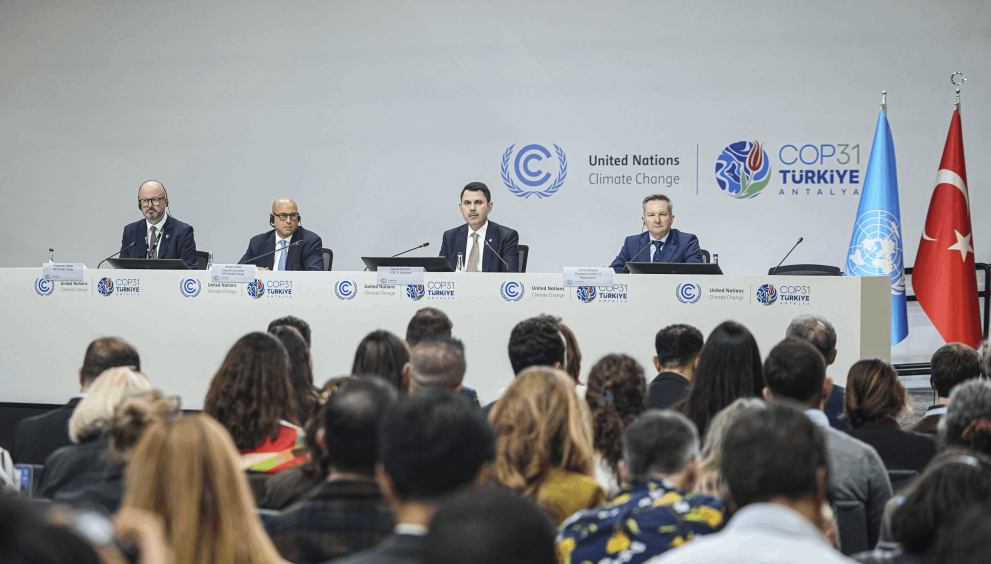
The COP31 climate conference in Antalya has exposed deep divisions among countries, with negotiators failing to secure clear commitments on phasing out fossil fuels, delivering adequate climate finance and addressing the urgent needs of vulnerable nations. Despite several investment announcements and new initiatives, the latest draft outcome has fallen short of expectations on some of the most critical issues facing the climate crisis.
One of the biggest disappointments is the absence of a direct commitment to phase out fossil fuels. While the first draft called for accelerating the transition away from fossil fuels, the revised versions removed the explicit language, reflecting strong divisions among countries.
Panama’s Environment Minister Juan Carlos Navarro strongly criticised the influence of the fossil fuel industry, describing it as the “petroleum mafia”. He called for a global cap on oil production and warned that his country would formally object to the final decision if its key demands were not reflected.
The disagreement highlights a broader failure to translate scientific warnings into concrete political action. Although the draft reaffirms the goal of limiting global warming to 1.5°C, it does not establish a clear timeline or binding measures to reduce fossil fuel dependence. Current national climate plans could still lead to around 2.6°C of warming, according to the draft.
Climate finance promises remain uncertain
Climate finance has remained another major point of contention. The revised draft calls for efforts to at least triple adaptation finance by 2035 but fails to establish a clear financial baseline for measuring the increase. A roadmap on adaptation and resilience finance, known as the “Antalya–Addis Ababa Roadmap”, is proposed, with further discussions expected in 2027.
The draft also recalls Article 9.1 of the Paris Agreement, reaffirming the responsibility of developed countries to provide financial support to developing nations. However, it contains no specific country-by-country contributions or firm guarantees on when the money will be delivered.
The situation is particularly concerning for countries such as Bangladesh, which face increasingly severe cyclones, floods, river erosion, salinity intrusion and displacement. Although the draft calls for increased funding for the Loss and Damage Fund, it provides no specific new financial commitments.
The scale of the funding gap is evident in the figures included in earlier negotiating documents: around US$2.8 billion was requested under the Barbados Implementation Modalities to address climate-related loss and damage, while allocations stood at approximately US$342 million.
Electrification without a clear clean-energy guarantee
The draft promotes a global target to meet 35% of final energy consumption through electricity by 2035. It also encourages the expansion of renewable energy, improvements in energy efficiency, stronger electricity grids and energy storage.
However, it does not specify that the additional electricity must come from clean sources. This raises concerns that increased electrification could still rely on coal and gas, potentially reinforcing dependence on fossil fuels.
The text also supports scaling up carbon capture, utilisation and storage technologies to gigatonne levels by 2035. At the same time, it warns that carbon removal technologies must not become a substitute for deep emissions reductions or delay climate action.
Just transition and vulnerable communities
The draft recognises the importance of a science-based and equitable just transition, including workers’ rights and social equality. However, it does not establish binding financial commitments for worker retraining, income protection or social security.
For Bangladesh, the issue is particularly important as workers in the garment, transport, construction, energy and informal sectors face potential livelihood risks during the transition to a low-carbon economy.
The draft also retains provisions on the participation of women, children, young people and Indigenous Peoples. It calls for implementation of the Belém Gender Action Plan for 2026–2031 and recognises the role and rights of Indigenous and local communities. However, it lacks a clear provision on the participation of persons with disabilities.
Proposals on mountain and glacier-dependent communities, ocean monitoring, early warning systems and nature-based solutions offer some progress, but many initiatives remain dependent on existing funding sources rather than dedicated financial support.
Investment announcements fail to resolve the political deadlock
Alongside the negotiations, COP31 has seen several major green investment announcements. Türkiye secured green investment partnerships worth more than US$26 billion, including renewable energy cooperation with China and investment plans involving the European Bank for Reconstruction and Development and development banks.
Norway, Canada and the United Kingdom pledged to mobilise US$10 billion in climate finance by 2030. The Asian Development Bank, Green Climate Fund, Cook Islands and Palau also launched a programme to mobilise more than US$1 billion for 14 Pacific island communities.
Other announcements included US$480 million to reduce methane and other super pollutants, a further US$25 million for the Super Pollutant Country Action Accelerator, and a US$70 million bond from the International Fund for Agricultural Development.
Electrification also emerged as a major priority, with companies, business organisations and electricity-sector alliances backing the “35 by 35” initiative and announcing plans for significant investment in clean power, grids and energy storage.
However, voluntary pledges and private investment announcements cannot replace the formal climate finance responsibilities of developed countries under the Paris Agreement. Questions remain over whether vulnerable developing nations will receive an equitable share of the promised resources.
What does COP31 mean for Bangladesh?
For Bangladesh, the outcome highlights the need for stronger climate diplomacy and a clear strategy to secure finance for adaptation, loss and damage and a just transition.
The country needs to push for a transparent baseline and measurable commitments under the adaptation finance target, as well as new and accessible funding for communities already suffering climate-related losses.
Bangladesh must also prepare investment-ready projects in solar energy, electricity grids and energy storage to benefit from the global shift towards electrification. Opportunities to secure methane-reduction funding for rice cultivation, waste management and livestock should also be explored.
The country’s just transition roadmap, which requires an estimated US$1.85 billion for implementation, will need substantial financial and technical support to protect workers’ livelihoods while reducing industrial emissions.
A widening gap between promises and action
COP31 has produced investment announcements, new initiatives and renewed recognition of several climate priorities. Yet the central challenges remain unresolved: a clear pathway away from fossil fuels, predictable adaptation finance and adequate resources to address loss and damage.
For climate-vulnerable countries, the real measure of success is not the number of declarations or investment announcements, but whether commitments translate into accessible funding, stronger resilience and protection for people on the front lines of climate change.
In that sense, Antalya risks becoming another example of the widening gap between political promises and the urgent action demanded by the climate crisis.