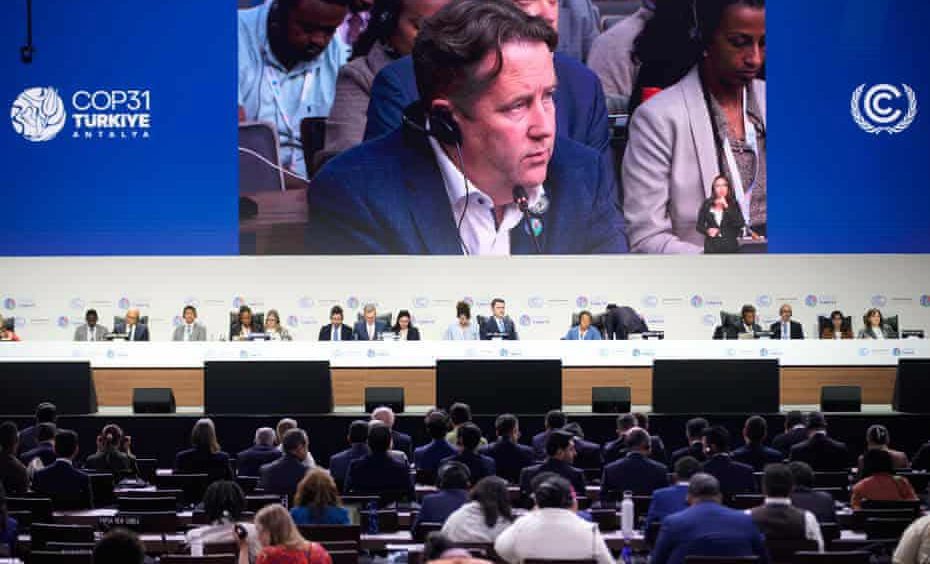
The European Union (EU) has come under criticism from climate activists after rejecting the proposed final climate agreement at COP31, with campaigners questioning whether the bloc can claim climate leadership while resisting greater financial support for developing countries.
The EU announced its rejection of the proposed agreement during the closing stages of the UN climate conference in Antalya, Türkiye. Ireland’s Minister for Climate, Energy and the Environment, Darragh O’Brien, made the announcement on behalf of the bloc.
Countries ultimately failed to reach consensus on the overarching political agreement, bringing COP31 to a close without the proposed pact.
The EU opposed the draft because it used weak language on transitioning away from fossil fuels and included ambitious targets for carbon capture. Some climate activists also criticised the proposed text. However, they questioned whether the EU was prepared to take financial responsibility for the transition it was demanding.
Climate campaigner Harjeet Singh said the draft was unacceptable to many developing countries and civil society organisations. In a social media post, he said it offered no funding for people affected by climate disasters, lacked a clear plan to phase out fossil fuels and instead included targets for carbon capture on a gigaton scale.
However, Singh argued that the EU’s own negotiating position also deserved scrutiny. He alleged that the bloc arrived in Antalya without making any significant new commitments to climate finance, describing its approach as coming to the negotiations with “empty pockets”.
According to Singh, the EU not only failed to pledge new funding for adaptation and loss and damage but also blocked efforts behind closed doors to establish a meaningful Just Transition Mechanism, while demanding stronger language on fossil fuels.
He also questioned the consistency between the EU’s climate commitments and its continued expansion of fossil fuel infrastructure in Europe.
“Rejecting the draft because it lacks fossil fuel language and relies on carbon capture greenwashing is the right thing to do. But doing so without paying for the transition is hypocrisy,” Singh said.
“You cannot demand ambition from developing countries while refusing to provide the money to deliver it. The transition must be fair, fast and funded otherwise, it is not climate justice,” he added.
Allegations of a Climate Finance Deadlock
The criticism follows concerns raised earlier during the summit. At a press conference organised by Climate Action Network (CAN) International, Teresa Anderson of ActionAid International criticised developed countries for blocking progress on climate finance.
Addressing the EU’s position on new climate funding, CAN later said that not everyone within the bloc shared the outlook of its own climate chief, who had described the issue as “dead in the water”.
The network said the EU needed to demonstrate through concrete action, rather than words, that it was prepared to move beyond that position and provide the funding people need to survive the climate crisis.
Accusations of ‘Shameless Cruelty’
Brandon Wu, Director of Policy and Campaigns at ActionAid USA, voiced similar criticism in a LinkedIn post.
He urged Western journalists covering COP31 not to portray the EU as a climate champion simply because it rejected the proposed draft.
Wu argued that the bloc had not approached negotiations in good faith on priorities of the Global South, including climate finance, just transition and adaptation.
He also questioned the ambition of the EU’s proposed roadmaps for phasing out fossil fuels, saying they largely repeated existing policies that were “nowhere near aligned” with the 1.5°C temperature limit.
Describing the EU’s position at the closing plenary as a “performative outburst” after two weeks of negotiations, Wu accused the bloc of withholding the finance needed for a fossil fuel transition throughout the talks before raising objections at the last moment over the absence of fossil fuel phase-out language in the draft.
He also alleged that the EU made its intervention without proper authorisation.
Wu further claimed that EU representatives left the negotiating room to hold their own media briefing while the African Group was speaking about the need for climate finance.
“This is the height of narcissism and arrogance,” he wrote.
He also expressed frustration that many media outlets were portraying the EU as a climate champion because of its rejection of the draft.
Growing Divisions Over Climate Responsibility
The criticism highlights widening divisions between developing countries and wealthy blocs over who should bear the costs of climate action and how the global transition away from fossil fuels should be financed.
Adaptation finance, funding for loss and damage, a meaningful Just Transition Mechanism and financial support for moving away from fossil fuels were among the major points of disagreement at COP31.
For climate-vulnerable countries such as Bangladesh, the dispute exposes a fundamental contradiction in global climate diplomacy. Developing countries are expected to reduce emissions, strengthen adaptation and accelerate the transformation of their energy systems, while the funding required to achieve these goals remains inadequate.
For countries like Bangladesh, the issue is not only how much climate finance is provided but also how it is delivered. If new climate funding comes in the form of additional loans, it could deepen existing economic pressures in countries that have contributed relatively little to the climate crisis but face some of its most severe impacts.
Climate justice advocates therefore emphasise the need for grant-based, accessible and predictable finance rather than additional debt.
They argue that the transition away from fossil fuels cannot be separated from financing, equity and social justice. Demanding greater ambition without adequate financial support risks placing an unfair burden on developing countries.
Keeping the 1.5°C limit within reach requires more than political declarations on moving away from fossil fuels. The transition must also account for workers’ livelihoods, the rights of local communities, energy security and the financial capacity of developing countries.
Without adequate funding and social protection, changes to energy systems could create new forms of inequality.
The transition away from fossil fuels is not simply an energy-sector shift; it is also an economic and social transformation. Unless its costs and responsibilities are shared fairly, the ambition to achieve the 1.5°C target will remain difficult to realise.
Climate ambition without finance, and energy transition without social justice, cannot deliver climate justice.