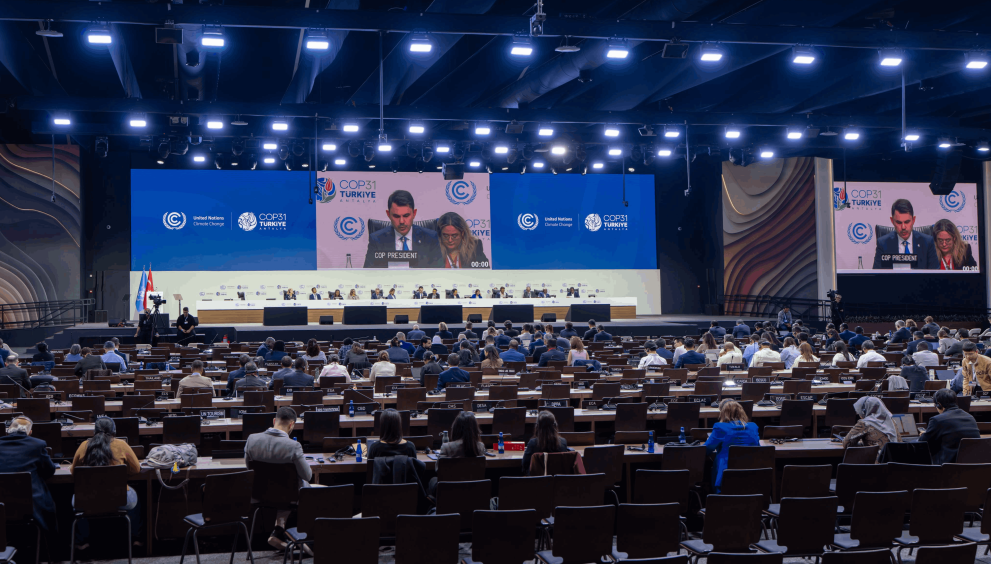
Negotiations at the UN Climate Change Conference (COP31) remain deadlocked, with 21 agenda items unresolved as of Thursday morning, according to the COP31 Presidency.
Although negotiators reached agreement on a draft decision to provide expert support to least developed countries (LDCs), major disagreements remain over adaptation finance, loss and damage funding and the future of fossil fuels.
Ministers are facing two key questions ahead of the conference’s scheduled conclusion on Friday: whether to increase adaptation finance to at least US$120 billion and whether the final decision will include a call for phasing out fossil fuels.
Adaptation Finance Dispute At COP30 in Brazil, countries called for adaptation finance to be tripled by 2035 but failed to agree on a baseline. An earlier COP31 draft proposed raising adaptation finance to at least US$120 billion, although it did not specify whether this would be an annual target.
The European Union has opposed new financial commitments, saying it will fulfil existing pledges while prioritising faster access to funding for the poorest countries and small island states. According to the UN Environment Programme, developing countries will need approximately US$305 billion annually by 2035 to adapt to climate change.
Loss and Damage Funding Developing countries are demanding greater transparency over financial pledges and actual contributions to the Fund for Responding to Loss and Damage. They also want clearer guidance to ensure that funding reaches communities quickly after disasters such as cyclones and floods.
However, the EU argues that decisions on disbursement procedures should remain with the fund’s board. No agreement was reached on Wednesday. Fossil Fuels and Energy Transition Türkiye has proposed that electricity account for at least 35 per cent of global end-use energy consumption by 2035, up from around 23 per cent today.
While the EU supports the target, it wants a clear commitment to generating additional electricity from clean sources. Negotiators also remain divided over two competing proposals on fossil fuels. One calls for accelerating the transition away from fossil fuels, following the 2023 Dubai agreement, while the other explicitly calls for phasing out their use.
Second Global Stocktake Begins The second Global Stocktake under the Paris Agreement began on Wednesday. The five-yearly process assesses collective progress on emissions reduction, climate adaptation and support for developing countries.
The review is scheduled to conclude in 2028 and will assess progress since the first Global Stocktake in Dubai.
Indigenous Rights and Critical Minerals Indigenous representatives have raised concerns about their limited participation in decisions concerning minerals needed for the global energy transition. Research led by the University of Queensland identified 5,097 mining projects involving nearly 30 transition minerals. Around 54 per cent are located on or near Indigenous lands.
Advocates are calling for Indigenous communities to receive adequate information and have the opportunity to give or withhold their free, prior and informed consent before projects are approved.
Negotiations Continue Disagreements also persist over emissions reduction, carbon credits, climate technology financing and public participation. The conference is scheduled to end on Friday, November 20. With major issues still unresolved, negotiators face continued pressure to reach consensus on climate finance and the global energy transition before the closing session.