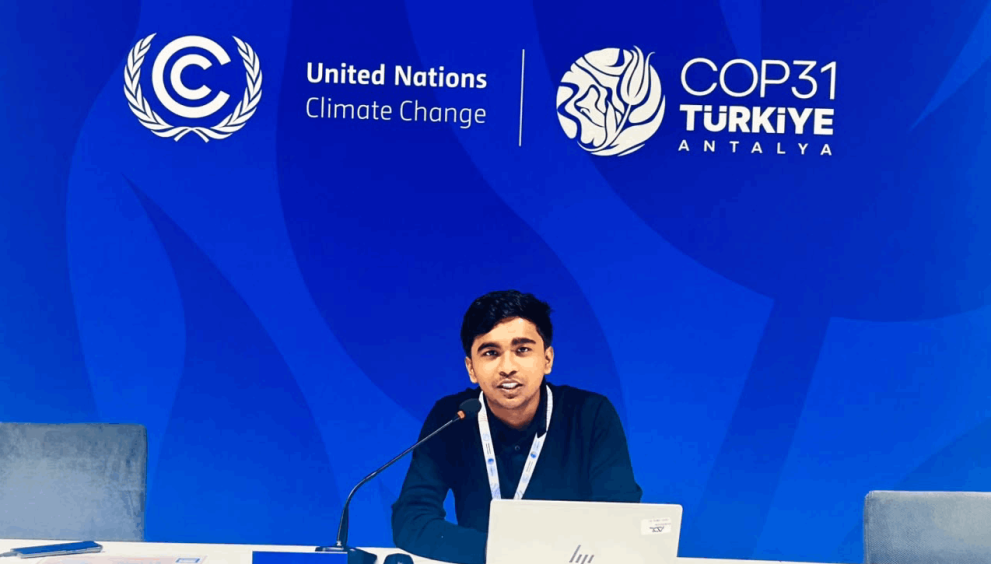
As the impacts of climate change continue to make homes, livelihoods, agriculture, access to safe drinking water, and the future increasingly uncertain for people in Bangladesh’s coastal communities, the United Nations Climate Change Conference, COP31, is taking place in Antalya, Türkiye. With representatives from nearly 200 countries participating, expectations surrounding the conference are high. However, for a climate-vulnerable country like Bangladesh, the most important question is: What will we actually gain from this conference? Will it bring new promises, or will it finally deliver on the commitments made in previous years?
Every year, COP conferences take place. Discussions are held, declarations are announced, and new targets are established. Yet, for people living in southern Bangladesh, the success of a climate conference is measured differently. For them, success means having the means to rebuild homes after cyclones, protecting agricultural land from salinity intrusion, ensuring access to safe drinking water, rehabilitating people who have lost their homes to river erosion, and establishing effective support systems for those whose livelihoods have been disrupted by climate change.
COP31: Implementation at the Centre of Discussions, but Where Is the Consensus?
One of the key priorities of COP31 is accelerating the implementation of existing climate commitments. Achieving the goals of the Paris Agreement, strengthening adaptation capacity, mobilising climate finance, and ensuring a just transition away from fossil fuels are among the central issues under discussion.
However, alongside the expectations generated by the conference, significant disagreements remain. Differences among countries are particularly evident regarding the language and timeline for transitioning away from fossil fuels. Some parties want to maintain the position adopted at COP28 in 2023 on transitioning away from fossil fuels, while others are calling for a clearer commitment to phasing out their use. Discussions reported up to 17 November indicate that reaching consensus on climate finance, adaptation, and fossil fuels remains challenging. The decisions emerging in the final phase of the conference will therefore be particularly important. One point must be kept in mind: draft decisions are not the same as final decisions. Although the draft released on 16 November contains several ambitious proposals, they remain under negotiation.
Climate Finance: Bangladesh’s Biggest Expectation
Climate finance is one of the most important issues for Bangladesh at COP31. According to statements made by the Bangladesh delegation at COP31, the country requires approximately USD 10–11 billion annually to address climate change. However, accessing international climate finance remains difficult due to complex procedures, lengthy administrative processes, and delays in disbursement.
Bangladesh should insist that this financing must not be debt-dependent. The country has contributed very little to the historical causes of climate change, yet its people are bearing a disproportionate share of the consequences. Therefore, grant-based finance for adaptation and addressing climate-related losses and damage is essential. At COP31, Bangladesh is calling for easier access to international climate funds, faster disbursement, adequate financing for loss and damage, and increased investment in renewable energy. Particular attention is being given to protecting vulnerable communities in coastal regions, haor areas, chars, and drought-prone parts of the country. The question now is: How much of these demands will actually be translated into action?
Adaptation and Loss and Damage: Why Are They So Important for Bangladesh?
In Bangladesh, climate change is not merely a matter of rising temperatures or irregular rainfall. It is a crisis affecting people’s lives and livelihoods. In coastal districts such as Barguna, Patuakhali, Satkhira, Khulna, and Bagerhat, salinity intrusion, cyclones, storm surges, river erosion, and shortages of safe drinking water are part of everyday life. The consequences extend beyond the environment, affecting education, health, the economy, the safety of women and children, and the social well-being of communities. In this context, Adaptation Finance and the Loss and Damage Fund are critically important for Bangladesh.
The draft decision presented on 16 November at COP31 includes a proposal to increase annual adaptation finance for developing countries to at least USD 120 billion by 2035. Another proposed initiative, the “Antalya-to-Addis Ababa Roadmap on Adaptation and Resilience Finance,” aims to explore sources of financing and improve access to funding for adaptation and resilience. This could represent an important step forward. However, Bangladesh must ask: How will this money reach the people who need it? Through what mechanisms will coastal communities benefit? Will local institutions, youth organisations, and climate-vulnerable communities have meaningful opportunities to participate in decision-making and financing processes? Announcing funds at the international level is not enough. The benefits must reach people on the ground.
What Should Bangladesh Gain, and What Should It Demand?
Bangladesh’s expectations from COP31 should be clear and focused on several priorities. First, adequate, predictable, and grant-based financing must be ensured for adaptation and addressing climate-related loss and damage. Second, complicated procedures for accessing climate funds must be simplified. Countries facing the highest levels of climate vulnerability should have faster and more effective access to financial support. Third, investment must increase in climate-resilient infrastructure, safe drinking water, climate-resilient agriculture, early warning systems, and the rehabilitation of displaced people in coastal communities. Fourth, Bangladesh must reduce its dependence on fossil fuels and ensure a just transition towards renewable energy. However, this transition must take into account the realities of developing countries, their energy security, and their economic capacities. Fifth, meaningful youth participation in climate policymaking must be ensured. Giving young people opportunities to attend conferences or speak at side events is not enough. Their roles must also be recognised in decision-making, implementation, and accountability processes.
Promises Are Not Enough; Accountability Is Essential
One of the biggest weaknesses of climate conferences is the persistent gap between commitments and implementation. Past experiences show that although international financing targets are announced, significant gaps remain in the actual flow of funds, accessibility, and delivery of financial support to affected communities. At COP29 in 2024, developed countries agreed to a climate finance target of at least USD 300 billion annually for developing countries by 2035. At the same time, efforts were outlined to scale up financing from all sources to USD 1.3 trillion annually. However, questions remain regarding the sources of finance, the balance between grants and loans, and accountability for implementation. Every financial commitment must be accompanied by a clear timeline, identified sources of funding, an implementation framework, and a mechanism for reviewing progress. Otherwise, new announcements will fail to bring meaningful change to people living on the frontlines of the climate crisis.
Are the Voices of Coastal Youth Reaching the Global Stage?
As a climate and environmental activist, I believe that the experiences of coastal communities must receive greater attention in Bangladesh’s climate discussions. Although climate change is widely discussed at the international level, the lived experiences and expectations of affected people often receive insufficient attention. As a young person from a coastal district like Barguna, I know that climate change is not a distant threat for us. It is a reality of our present. Salinity intrusion, river erosion, cyclones, and livelihood insecurity are affecting the education, employment opportunities, and future plans of the younger generation.
Therefore, Bangladesh’s position at COP31 must not remain limited to diplomatic statements. The country’s delegation must advocate for an international position that reflects the actual needs of its most vulnerable communities.
In particular, the voices of young people, women, farmers, fishers, marginalised communities, and people displaced by climate change must be given meaningful attention.
Ultimately, Where Does the Success of COP31 Lie?
The success of COP31 will not be determined by the language of its final declaration alone. It will be measured by how effectively its decisions are implemented in reality. For Bangladesh, announcing new climate finance commitments is not enough. What matters is whether the funding comes in the form of grants, whether it is disbursed on time, and whether the most vulnerable communities actually benefit from it.
We must remember that those who have contributed the least to climate change are bearing the greatest burden of its consequences. Addressing this inequality is not merely an environmental responsibility; it is a matter of climate justice. Bangladesh’s expectations from world leaders should be clear: we no longer want to hear promises alone. We want commitments to be implemented, climate finance to be fair, and the lives of affected communities to experience visible improvements. For the people of Bangladesh’s coastal regions, the success of a climate conference is not defined by a diplomatic document. It means the right to live safely, the protection of livelihoods, and a habitable planet for future generations.
If COP31 truly aims to be a conference of implementation, the world must finally prove that climate justice is not merely a subject of discussion, but a responsibility that must be fulfilled through concrete action.
COP31: From Promises to the Test of Implementation What Will Bangladesh Actually Gain