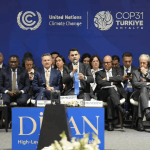
A revised draft of the main decision text at the UN Climate Change Conference (COP31) has dropped an explicit call for countries to accelerate the transition away from fossil fuels, raising concerns among climate advocates.
Released on Thursday by the COP31 Presidency, the 80-paragraph draft instead calls on countries to reflect the outcomes of the first Global Stocktake in their national climate and adaptation plans.
Panama has demanded a global cap on oil production at current levels. Environment Minister Juan Carlos Navarro warned that his country would formally object during the closing plenary if its demands were not reflected in the final decision.
He also criticised the influence of the oil industry, saying the world was being held hostage by the “petroleum mafia”.
Adaptation finance remains unresolved The draft calls for adaptation finance to be tripled by 2035, but countries have yet to agree on the baseline for measuring the increase.
Developing countries are estimated to need around US$305 billion annually by 2035 to adapt to climate change.
The draft also proposes an “Antalya to Addis Ababa” roadmap to identify reliable sources of adaptation finance and improve access to funding.
Meanwhile, approximately US$2.8 billion has been requested under the Barbados Implementation Modalities to address climate-related loss and damage, against an allocation of only US$342 million.
Concerns over energy and climate ambition The draft proposes that electricity account for 35 per cent of global end-use energy consumption by 2035. However, it does not require the additional electricity to come from clean sources.
It also calls for tripling renewable power generation capacity by 2030. According to the draft, global warming could reach approximately 2.6°C even if countries fully implement their national climate plans.
Gender, disability and food security concerns The revised text removes references to the word “gender”, persons with disabilities and food security.
It also drops an explicit call to implement the Belém Gender Action Plan. Diplomats told POLITICO that Russia and the Vatican had sought to remove references to gender, while the European Union opposed the move.
References to children, young people, Indigenous Peoples and local communities remain in the draft. Health-related provisions have also been shortened, with references to climate-damaged health facilities and public health early warning systems removed.
Mountain programme proposed The draft proposes a programme under the Nairobi Work Programme to address climate change impacts in mountain regions and glacier-dependent communities. However, the initiative would rely on existing funding sources, with no dedicated fund announced.The conference is scheduled to conclude on Friday, November 20. COP31 President Chris Bowen said negotiations would continue late into Thursday night in an effort to reach consensus.