Young climate activists and youth representatives from Bangladesh, India, Nepal, and Pakistan have put forward an eight-point set of demands to ensure meaningful youth leadership, climate financing, participation in policymaking, and direct involvement in climate action. They emphasized that young people should not be limited to speaking opportunities at international conferences; rather, they must be actively involved at every stage of climate planning, decision-making, and implementation.
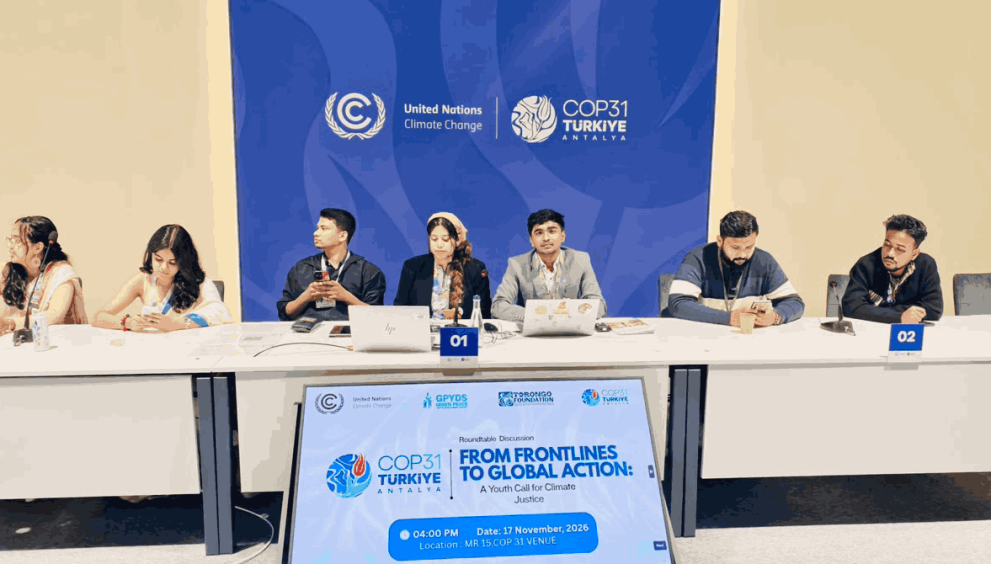
The call was made at Meeting Room 15 at the venue of the COP31 Climate Conference in Antalya, Türkiye. The international roundtable was jointly organized by Green Peace Youth Development Society (GPYDS) and Taranga Foundation. The event was titled “Beyond Promises: Youth-Led Climate Action and Global Accountability – A Global Youth Roundtable from Climate Commitments to Implementation.”
Young climate activists, youth organizers, and representatives from Bangladesh, India, Nepal, and Pakistan participated in the discussion. They highlighted the climate challenges facing their respective countries, local adaptation initiatives, and the importance of regional cooperation in advancing climate justice.
The session was chaired by Khairul Islam Munna, Founder and Executive Director of Green Peace Youth Development Society (GPYDS), and moderated by Jaita Biswas, Founder of Taranga Foundation.
Speaking on behalf of Bangladesh, Shah Rafayet Chowdhury, Founder of Footsteps, said that climate change is an everyday crisis for people in vulnerable countries like Bangladesh, affecting their lives and livelihoods. Young people are already working on adaptation initiatives at the local level. Therefore, they must be involved not only in discussions but also in planning and implementation.
Representing India, youth delegate Rijjul Madan said that the experiences and innovative ideas of young people must be incorporated into climate policymaking. He also stressed the importance of ensuring equal opportunities for youth from developing countries to participate in international climate negotiations.
Nepalese youth representative Sneha Upreti emphasized that the experiences of local communities and young people must be prioritized in climate adaptation planning. She also highlighted the need for regional cooperation and long-term support for youth-led initiatives.
Pakistan’s youth representative, Mohammad Ali, said that young people should not be confined to awareness-raising activities but must be included in planning, decision-making, and implementation. He also called for stronger cooperation among young people across countries to address the climate crisis.
Eight-Point Demands from Youth
During the roundtable, participating representatives presented eight specific demands to world leaders, governments, and international organizations:
Direct Climate Finance: Ensure accessible grants and funding for youth-led climate initiatives.
Participation in Policymaking: Include young people in the formulation and implementation of national climate policies, plans, and programmes.
Locally Led Adaptation: Increase support for adaptation initiatives led by coastal, mountainous, and other climate-vulnerable communities.
Addressing Loss and Damage: Ensure adequate grant-based support for communities affected by climate change.
Climate Education and Green Employment: Expand opportunities for young people in climate education, research, technology, and green jobs.
Just Energy Transition: Reduce dependence on fossil fuels and ensure a just transition towards clean and renewable energy.
Transparency and Accountability: Engage young people in monitoring climate commitments, financing, and project implementation.
International Participation: Remove barriers related to visas, travel, and funding to ensure meaningful participation of young people from developing countries in international climate conferences.
A Collective Call for Youth Engagement in Global Climate Discussion During the discussion, participants emphasized that the climate crisis is not the problem of any single country. Therefore, young people across Asian countries must strengthen experience-sharing, joint initiatives, and mutual cooperation. They also stressed that the experiences and demands of climate-vulnerable communities must receive greater attention in international policymaking.
In his closing remarks, Khairul Islam Munna, Founder and Executive Director of Green Peace Youth Development Society (GPYDS), emphasized the importance of bringing the experiences of frontline climate-vulnerable communities into international discussions and transforming youth-led initiatives into practical solutions. He highlighted the need for financing, technology, capacity-building, and policy support to make this possible.
He called upon world leaders and international organizations to move beyond promises and provide young people with real responsibilities, adequate resources, and meaningful opportunities to participate in decision-making processes.
One of the key outcomes of the roundtable was the development of a Joint Youth Climate Declaration, reflecting the perspectives of participating countries. The declaration outlined collective demands on climate justice, youth leadership, direct climate finance, locally led adaptation, and meaningful participation at the international level.
According to the organizers, the initiative aims not only to create a platform for international dialogue but also to establish long-term cooperation among young people from different countries and connect local climate initiatives with global policy discussions.
The participants called upon world leaders to translate commitments made at climate conferences into concrete actions and ensure meaningful youth leadership, initiatives, and participation in addressing the climate crisis.
The message from young people is clear: Beyond promises, we demand implementation. Beyond symbolic participation, we demand meaningful leadership in climate solutions.