
Data analysis of Bangladesh’s FY2026-27 climate budget suggests several highly vulnerable districts receive far less visible funding than their population-and-climate-risk share, while a lack of geographic disclosure makes it impossible to fully judge whether climate money is reaching those who need it most.
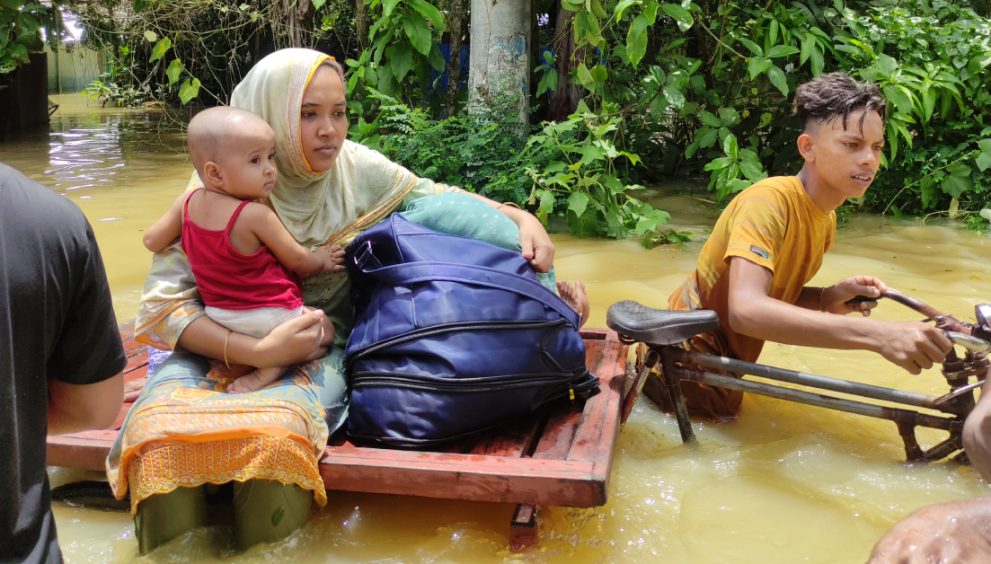
On the bank of the Meghna River in Hijla, Barishal, 65-year-old Meher Nigar lives with the constant possibility that her home may disappear into the river.
Her seven-member family shares a single room with walls made partly from rice straw and a roof of old corrugated iron. Two blue plastic drums hold clothes and household belongings, kept ready partly because they may float if erosion suddenly forces the family to flee.
The Meghna was only about 15 feet from her home during a reporting visit. Four years earlier, according to the family, their homestead, farmland, cowshed and family burial ground stood roughly 200 metres from the present riverbank.
The family has already been displaced four times.
“People think about food, about treatment, about education. We think first about saving our lives,” Meher said.
Her experience illustrates a much larger question facing one of the world’s most climate-vulnerable countries: Does Bangladesh’s climate money actually follow climate risk?
A data-driven investigation into the government’s FY2026-27 climate budget has found that the answer cannot yet be established with confidence. More than half of the gross annual budgets attached to climate-tagged development projects cannot be assigned to any district using information published in the government’s climate-finance report.
And among the portion that can be geographically identified, several districts facing high climate vulnerability appear to receive far less visible funding than would be expected from their population and climate-risk levels.
Tk 51,746 crore for climate activities
Bangladesh has identified Tk 51,746.16 crore for climate-related activities in FY2026-27, including Tk 37,132.43 crore in climate-relevant development allocations.
But the government’s climate-finance report primarily organises projects by ministry and project title. It does not provide a comprehensive district-level account showing how much climate-related funding is allocated to each area, how many vulnerable people are expected to benefit, or how allocations correspond with climate risk.
The investigation examined every machine-readable development-project entry found in Annex 2 of the government’s climate budget report.
While the report’s narrative refers to 522 projects, the annex contains 521 identifiable project-code rows, with combined gross annual project budgets of Tk 87,868.62 crore.
Of those 521 entries, only 255 projects, carrying about Tk 43,346.47 crore, contained enough geographic information in their titles to associate them with at least one district.
That means just 49.3 percent of the gross project budgets could be mapped to districts.
The other 266 project entries, worth approximately Tk 44,522.15 crore, were classified as national, regional or lacking a usable geographic destination.
Among them, 195 projects worth about Tk 32,246 crore did not state a usable location, 54 national or block projects accounted for around Tk 9,914 crore, and 17 region-only projects represented roughly Tk 2,363 crore.
This does not mean those programmes do not benefit vulnerable districts. National agriculture, forestry, energy or social-protection projects may reach communities across Bangladesh.
The problem is that the published data does not allow the public to determine where much of that money is intended to go.
Measuring the fairness gap
To examine the visible portion of the budget, the investigation developed a diagnostic “fairness index”.
A district’s share of geographically identifiable project budgets was compared with its share of national climate need, calculated using population and the district-level Climate Vulnerability Index, or CVI, developed under the LoGIC programme.
A score of 1 represents a visible allocation proportional to that population-and-vulnerability benchmark. A score below 1 indicates that the district has a smaller share of visible funding than its estimated share of need, while a score above 1 indicates a larger share.
The index is not an entitlement formula and does not prove that a district has been definitively underfunded. National projects may benefit districts without naming them, while major infrastructure built in one district may provide benefits extending far beyond its boundaries.
It does, however, expose striking disparities that require explanation.
Nilphamari disappears from the map
Among the most striking cases is Nilphamari.
The northern district has a CVI score of 0.52, placing it among Bangladesh’s more climate-vulnerable districts. Yet no FY2026-27 project budget could be assigned to Nilphamari using the geographic information contained in the published annex titles.
Its resulting visible fairness score is 0.00.
That should not be interpreted as proof that Nilphamari receives no climate-related public investment. Instead, it means the official climate-budget document does not provide enough location information to identify such investment at district level.
Other northern districts also appear near the bottom of the visible allocation ranking.
Bogura records a fairness score of 0.02, while Rangpur and Sirajganj each score about 0.04. Naogaon stands at 0.13, Tangail at 0.15, Dinajpur at 0.17 and Gaibandha at 0.20.
Four of the districts examined receive less than 5 percent of the visible project-budget share suggested by their population-and-climate-risk benchmark.
Read The Interactive Story.
Haor districts also fall below benchmark
The pattern extends into Bangladesh’s flood- and flash-flood-prone haor region.
Netrakona, which has a CVI of 0.52 and a poverty rate of 33.9 percent, has around Tk 164 crore in identifiable gross project allocations and a fairness score of just 0.30.
Sunamganj records a score of 0.36 and Kishoreganj 0.37.
Kishoreganj also has a poverty rate of 35.3 percent, highlighting how climate vulnerability can overlap with deep economic insecurity.
Even Patuakhali, which records the highest district CVI in the LoGIC dataset at about 0.56, scores only 0.68, below the proportional benchmark. Its identifiable gross project allocation is about Tk 289 crore.
Dhaka dominates the visible map
At the opposite end of the distribution is Dhaka.
Large infrastructure projects located in the capital give Dhaka the biggest concentration of geographically visible climate-tagged development funding.
Its fairness index reaches 5.53, meaning its share of identifiable project budgets is more than five times its share under the population-and-CVI benchmark used in the investigation.
That does not necessarily mean Dhaka residents receive five times more climate benefit. Large transport, drainage, water, institutional or other infrastructure located in the capital may provide national or regional services.
But the contrast reveals a structural problem in climate-budget accounting: major construction projects are relatively easy to locate geographically, while national programmes and dispersed investments can effectively disappear from the district map.
The result is a public budget that shows where many physical projects are built, but not necessarily where climate benefits ultimately flow.
Weak link between vulnerability and visible funding
The statistical analysis also found only a weak relationship between climate vulnerability and the visible funding distribution.
The Spearman rank correlation between district CVI and the fairness index was 0.26, with a p-value of approximately 0.04.
The finding does not establish why allocations differ. Project readiness, infrastructure pipelines, institutional capacity, development priorities and other policy considerations can all shape government investment decisions.
But it suggests climate vulnerability alone has relatively little influence over the geographic pattern visible in the published project data.
Climate finance specialist Zakir Hossain Khan, co-founder and managing director of Change Initiative, argued that both climate and nature vulnerability should become major criteria in allocation decisions, alongside population, poverty, disaster losses, project readiness and broader economic benefits.
He said geographic fairness cannot be properly evaluated when such a large share of climate-tagged spending lacks identifiable district destinations.
Government acknowledges planning gaps
Senior government officials have themselves acknowledged weaknesses in climate-sensitive development planning.
AKM Sohel, additional secretary and chief of the UN Wing at the Economic Relations Division, said climate considerations had not yet been fully integrated into development planning, contributing to fragmented initiatives.
He also called for stronger climate data and for research to extend beyond the country’s coastal belt into vulnerable areas elsewhere, including northern Bangladesh.
Yet official responses cited in the investigation did not provide the district-level allocation figures needed to determine how much nationally classified climate spending eventually reaches places such as Nilphamari, Netrakona or river-erosion-affected communities such as Meher Nigar’s in Barishal.
Transparency comes before fairness
The investigation therefore stops short of declaring that individual districts have definitively received too much or too little climate finance.
Allocations are not the same as expenditure. Expenditure is not necessarily the same as benefit. A project’s physical location may differ from the location of its beneficiaries, and district averages can obscure major inequalities between upazilas, unions and households.
But those limitations reinforce rather than weaken the central finding.
Bangladesh cannot credibly assess the geographic fairness of climate finance without publishing clearer information about where projects operate, which communities they are intended to serve and how much of each project’s budget actually qualifies as climate expenditure.
For families living at the frontline of climate risk, the issue is more than an accounting exercise.
Meher Nigar does not know which government programme, climate fund or development project should protect her family from the Meghna. She knows only that the river has already taken their land repeatedly and is again approaching their home.
Bangladesh’s climate budget can count hundreds of projects and tens of thousands of crores of taka.
What the public still cannot clearly see is whether that money follows the people facing the greatest risk.