
The Himalayan nation produces a negligible share of global emissions, yet a wall of ice, rock and water has killed hundreds, destroyed communities and exposed the brutal arithmetic of climate injustice.
At 8:40 on Wednesday morning, part of a Himalayan mountain appeared to come apart.
A lower section of a glacier near Langtang Lirung collapsed from more than 5,000 metres above sea level, crashing into the valley below and unleashing an avalanche of ice, shattered rock and sediment along the Nepal-China border.
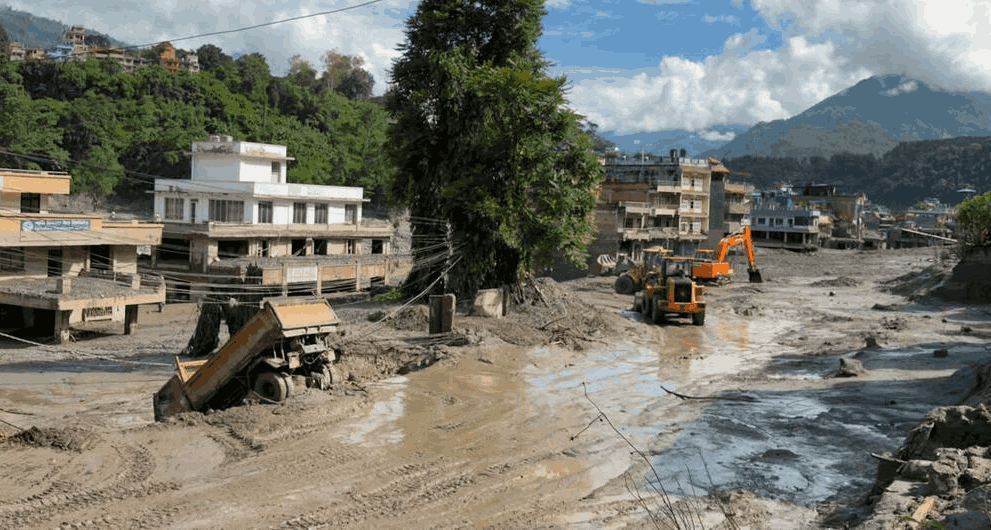
The avalanche accelerated through the Lhende Khola valley before becoming a vast debris flow. It tore into the Bhote Koshi and Trishuli river systems, sending a wall of mud, boulders and water through border facilities, hydropower projects, roads, bridges and settlements.
By Friday, the disaster had killed 547 people in Nepal and five in Tibet, according to the latest official figures reported by Reuters. Nearly 1,000 people remained missing across the two countries, including at least 540 foreign nationals, many of them trekkers and Hindu pilgrims travelling towards Mount Kailash and Lake Mansarovar.
More than 90,000 people are believed to have been directly affected. Entire villages have been destroyed, communities remain cut off and the gateway town of Syapru Besi has been devastated. Six health facilities were damaged and eight healthcare workers were missing, raising fears of disease as survivors crowd into temporary shelters with limited access to clean water and sanitation.
It is one of the deadliest disasters in Nepal’s recent history. It is also a stark illustration of a global injustice: Nepal has contributed almost nothing to the atmospheric pollution heating the planet, but its people are increasingly paying for the consequences with their homes, livelihoods and lives.
Older Nepali government data submitted through the United Nations system put the country’s contribution at about 0.027 percent of global greenhouse gas emissions. A World Bank assessment, using different accounting, placed the share at about 0.1 percent. By either measure, Nepal’s responsibility for the climate crisis is negligible.
Yet few countries face a more dangerous combination of melting glaciers, thawing mountain slopes, extreme rainfall, flash floods and fragile infrastructure.
A mountain turned into a flood
Satellite images taken before and after the disaster show that a large section of the glacier broke away near Langtang Lirung. The collapse plunged roughly 1,400 metres towards the valley floor, generating enough seismic energy to be mistaken initially for an earthquake.
Nepali officials first considered whether an earthquake had triggered the disaster. The US Geological Survey later said the seismic signal was generated by the collapse of glacial rock and ice and the debris flow that followed, rather than by a conventional tectonic earthquake.
The distinction matters. The mountain did not shake and then release the glacier. The collapse itself shook the earth.
An avalanche of rock and ice surged into the Lhende Khola and raced for more than 20 kilometres at an estimated speed of about 50 metres per second, or 180 kilometres per hour, according to a Chinese government geologist cited by Reuters. People in its path had only seconds to react.
At the Nepal-China border, surveillance footage showed the brown torrent swallowing immigration and customs buildings and sweeping away people attempting to escape. Satellite analysis indicated that almost every structure around the border complex stood inside the debris-flow zone.
From there, the flood descended more than 4,500 metres in elevation and altered river channels more than 100 kilometres downstream. Communities including Timure, Syapru Besi, Hakubesi, Betrawati, Trishuli and Devighat lay along its path.
At Galchhi, far downstream, the river reportedly rose by as much as nine metres in just 30 minutes. (
“It was a huge gush of mud coming straight towards us,” 68-year-old survivor Keshav Prasad Baral told Reuters. He said his wife was swept away as they tried to reach the terrace of their home.
Another survivor, Dibga Tamang, was airlifted from Rasuwa to an army camp in Nuwakot.
“All of our people have gone. They are dead,” Tamang said.
Rescue teams have used helicopters, sniffer dogs and boats to reach isolated settlements and search fields and riverbanks for bodies. Roads and bridges remain impassable in several areas, limiting the movement of relief supplies.
The danger has not completely passed. The collapse created a barrier lake upstream, where the volume of water increased to more than 2.5 million cubic metres. Its overflow briefly forced rescuers on both sides of the border to withdraw before authorities judged the immediate risk manageable. Officials continue to warn about secondary floods, further landslides and the possible failure of other unstable slopes.
Climate link requires care, but cannot be ignored
Scientists have not concluded that climate change was the sole or immediate trigger for the Langtang Lirung collapse. A full attribution study will require detailed analysis of temperature, snowfall, rainfall, glacier movement, rock structure, permafrost and seismic conditions.
But the absence of an immediate attribution does not mean the disaster occurred outside the climate crisis.
The important distinction is between a trigger and the conditions that make a catastrophe more likely. Rising temperatures can melt the ice that supports steep slopes, fill fractures with water, alter freeze-and-thaw cycles and thaw the permafrost that binds fractured rock together.
“Climate change is generating conditions that can destabilise high-mountain rock and ice,” Simon Cox, chief scientist at Earth Sciences New Zealand, told Reuters. Scientists cautioned against calling warming the sole trigger, but said glacier retreat, snowmelt and changing rainfall patterns probably contributed to the instability.
The mountains can be imagined as immense masses of shattered stone held together partly by frozen joints. As that ice warms and disappears, the natural cement weakens. A slope that remained stable for centuries can suddenly collapse, carrying glaciers, boulders and accumulated meltwater with it.
Recent heat may have added to the danger. Ground temperatures measured near the disaster site reached their highest level in two years shortly before the collapse, while monsoon rainfall had saturated surrounding slopes and swollen rivers. Scientists are examining how those conditions interacted.
Such events are known as cascading or compound disasters. A glacier collapse becomes an avalanche; the avalanche becomes a debris flow; the debris blocks or displaces a river; the river becomes a flash flood; and the flood destroys infrastructure far beyond the original collapse zone.
The initial failure may occur in seconds, but its consequences can travel across borders and last for generations.
The Himalayas are losing their foundations
The Langtang disaster is not an isolated warning.
The Hindu Kush Himalayan region, sometimes described as the world’s “Third Pole”, contains the largest concentration of ice outside the Arctic and Antarctic. Its glaciers and snow sustain river systems on which nearly two billion people depend.
An ICIMOD assessment found that glaciers across the region disappeared 65 percent faster between 2011 and 2020 than during the previous decade. On the current global emissions pathway, the region could lose up to 80 percent of its existing glacier volume by the end of the century.
Two newer ICIMOD reports released in 2026 found that the rate of ice loss across the Hindu Kush Himalaya had doubled since 2000, with some glaciers losing the equivalent of up to 27 metres of ice thickness since 1975. (ICIMOD)
Nepal alone has lost close to one-third of its ice in slightly more than 30 years, according to the United Nations.
The consequences unfold in two apparently contradictory stages. Rapid melting initially creates larger lakes, stronger river flows and more destructive floods. As the glaciers continue to shrink, the long-term danger becomes water scarcity for farms, cities and ecosystems dependent on predictable meltwater.
The Intergovernmental Panel on Climate Change has concluded with high confidence that glacial lake outburst floods will threaten communities in High Mountain Asia. It also warns that glacier loss and permafrost thaw can have severe consequences for people, infrastructure and economies through floods, landslides and changing water availability.
Nepal has already seen the pattern. A cascading glacial lake outburst devastated Thame village in the Everest region in 2024, destroying homes, a school and a health facility and displacing 135 people. A separate flood struck the Nepal-Tibet border in 2025. Other catastrophic glacier-related surges have hit India’s Uttarakhand and Sikkim states.
The individual mechanisms differ, but the direction of risk is unmistakable.
A negligible emitter receives an enormous bill
The disaster exposes the imbalance at the heart of international climate negotiations.
A small group of large economies produces more than half of annual global greenhouse gas emissions. Nepal, by contrast, has pledged to reach net-zero emissions by 2045 while maintaining extensive forest cover and expanding renewable energy. Its domestic choices matter, but they cannot stabilise the Himalayan cryosphere without steep reductions in global fossil fuel use.
Nepal must nevertheless finance rescue operations, rebuild roads, hospitals and hydropower plants, relocate exposed communities and install monitoring systems across some of the world’s most difficult terrain.
Its National Adaptation Plan estimates that priority climate-adaptation programmes will cost $47.4 billion by 2050. Nepal expects to contribute $1.5 billion, leaving a need for $45.9 billion in external support.
Without stronger climate action, the World Bank estimates that Nepal’s economy could be at least seven percent smaller by 2050 than it would otherwise have been. Flooding, landslides, crop losses, water stress and heat-related damage threaten to reverse decades of progress in reducing poverty.
The Fund for Responding to Loss and Damage was created specifically to assist vulnerable developing countries facing economic and non-economic losses from climate impacts. The catastrophe in Nepal is now a test of whether the international climate-finance system can deliver money quickly, at sufficient scale and without pushing an already vulnerable country deeper into debt.
Emergency assistance is essential, but Nepal also needs long-term investment in satellite monitoring, high-altitude weather stations, glacier and permafrost observation, cross-border data sharing, river sensors, evacuation routes and early-warning systems that reach remote communities within minutes.
Hydropower plants, roads and settlements must be designed for hazards based on a warming future, not the climate conditions of the past.
No monitoring system can prevent a mountain from collapsing. It can, however, determine whether people downstream receive a warning before the water arrives.
For Nepal, the Langtang Lirung disaster has turned the language of climate negotiations into a landscape of mud, broken concrete and missing families. The country contributed almost nothing to the pollution destabilising the world’s glaciers, yet it must bury the dead and rebuild what the flood carried away.
That is no longer an abstract debate about future temperature targets. It is the present-day cost of climate injustice, measured in towns erased, communities displaced and hundreds of lives lost.