
Furnaces allegedly rebuilt days after a government drive in Savar show why demolitions cannot replace control of Bangladesh’s used-battery supply chain.
Illegal lead smelters allegedly returned to a village outside Dhaka within days of a government raid, highlighting an enforcement cycle that removes furnaces but leaves the money, materials and buyers behind.
The Department of Environment and local authorities conducted a joint mobile-court operation at Bhakurta in Savar on July 1. Officials dismantled six makeshift furnaces and three open-air kilns used to recover lead from discarded batteries. No operator was found at the site during the drive.
Habibur Rahman, a Department of Environment inspector, said fear and a culture of silence had made enforcement difficult because residents were reluctant to identify operators. He said the department would continue a zero-tolerance campaign against illegal lead processing.
Residents and local sources later told The Climate Watch that operators had erected six new furnaces in the Awal Market area, bringing the number they believed to be active to 12. They alleged that smelting resumed after dark, usually from about 7pm until 6am, releasing black smoke and an acidic smell that travelled two to three kilometres.
Those allegations had not been independently verified when reported. People accused of involvement either could not be reached, denied responsibility or said they would not restart the activity. The uncertainty is itself an argument for stronger evidence gathering rather than a reason to ignore the complaint.
Informal recyclers recover lead from used lead-acid batteries by breaking cases, draining acid and heating lead-bearing components. In an uncontrolled furnace, smoke and dust can carry lead into homes, soil, food, water and livestock. Acid can contaminate land and drains, while contaminated ash remains hazardous after the fire goes out.
Lead is a potent neurotoxin. Children are especially vulnerable because their brains and nervous systems are developing and they absorb a greater proportion of the lead they ingest. Exposure can reduce intelligence, impair learning and behaviour and damage organs. The effects on neurological development can be irreversible, and there is no known safe level of lead exposure.
Adults can suffer high blood pressure, kidney damage, reproductive effects and other illness. Smelter workers face direct exposure through smoke, dust and contaminated hands. They can also carry lead particles home on clothes, shoes, hair and tools, exposing children who never approach the furnace.
A 2020 analysis by UNICEF and Pure Earth estimated that 35.5 million Bangladeshi children had blood lead levels at or above five micrograms per decilitre, placing Bangladesh fourth among the most seriously affected countries in the model. It estimated an average population blood lead level of 6.83 micrograms per decilitre and economic losses equal to about 5.9 per cent of gross domestic product through reduced intelligence.
Those figures are modelled estimates published six years ago, not a current head count or a measurement of exposure in Bhakurta. They nevertheless show the national scale of concern and why a suspected smelter near homes should trigger environmental sampling and health surveillance.
Demolition is visible and sometimes necessary, but it addresses the final stage of a longer supply chain. A furnace can be rebuilt from brick and metal if dealers continue to deliver batteries, financiers provide cash, buyers purchase recovered lead and landowners allow the operation. Enforcement needs to follow those relationships.
Authorities should document battery brands, vehicle workshops, scrap dealers, transport routes, storage sites, lead buyers and payment records connected to each illegal unit. Seized material should be weighed and traced. Evidence should support prosecution of organisers and commercial beneficiaries, not only the labourers present when a raid begins.
Night operations demand night monitoring. The Department of Environment, police, local administration, fire service and electricity authorities need a joint protocol for rapid response, safe entry and evidence preservation. Satellite imagery cannot identify every small furnace, but drones, thermal cameras and targeted air sensors can help confirm repeated activity where legally authorised.
Residents need a reporting system that does not expose them to retaliation. A confidential hotline, case number and feedback mechanism would make it safer to share times, vehicle details and locations. Witness protection and enforcement against threats are essential when operators rely on local fear.
Environmental sampling should begin immediately after a site is identified. Teams should test surface soil, household dust, nearby ponds, drains, crops and ash using a transparent grid. Results should be compared with health-based standards and published with maps, laboratory methods and quality controls.
Children, pregnant women and workers in the affected area should have access to voluntary blood lead testing through qualified health facilities. Testing must be paired with clinical guidance and action to stop exposure. Screening people while allowing the source to continue would document harm without preventing it.
Cleanup is more complicated than levelling a kiln. Lead does not biodegrade. Contaminated soil may need removal, capping or other treatment, and waste must go to a secure facility. Officials should fence heavily polluted areas, prevent children from playing there and stop contaminated soil from being spread during construction or flooding.
The polluter should pay for remediation, but authorities need a plan when the operator disappears. A national fund financed through battery producers, importers and recyclers could cover urgent cleanup and later recover costs from responsible parties. Public money should not become a permanent subsidy for illegal business.
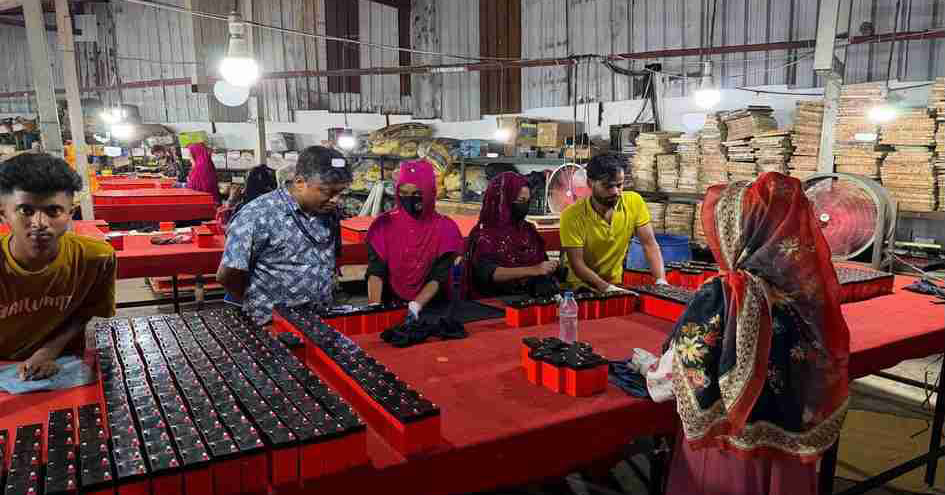
The legitimate recycling industry is part of the solution. Lead-acid batteries are widely used in vehicles, backup power and solar systems, and their lead has significant value. Licensed facilities with enclosed processes, emissions controls, worker protection and hazardous-waste management can recover that value more safely than backyard furnaces.
Formal facilities still require independent inspection. A permit cannot guarantee compliance, and poorly operated industrial plants can also contaminate communities. Continuous emissions data, worker blood testing, waste manifests and unannounced inspections should be conditions of operation.
Bangladesh also needs producer responsibility that reaches the end of a battery’s life. Manufacturers and importers should finance collection, accept returned batteries and account for every unit transferred to a recycler. A deposit-refund system could reward consumers and workshops for returning batteries through authorised channels.
Digital manifests can record the movement of used batteries from seller to collector, transporter and recycler. The system must be simple enough for small workshops and backed by physical inspections. Records without enforcement can create a paper trail that hides diversion rather than preventing it.
Public procurement can accelerate reform by requiring government vehicle fleets, power projects and contractors to buy batteries from companies with verified take-back systems. Banks and insurers can require environmental compliance before financing recyclers. Lead buyers should be prohibited from purchasing metal without proof of origin.
The recurring complaints from Bhakurta show the cost of treating illegal smelting as an isolated nuisance. It is a public-health emergency, an environmental crime and a supply-chain governance failure. Each rebuilt furnace signals that the economic system supporting the activity remains intact.
The next operation should therefore arrive with more than hammers. It should identify organisers, seize batteries and lead, preserve evidence, protect residents, test children, clean contaminated land and close the route back to the market. Only then will zero tolerance mean that the hazard has ended rather than moved to the next field.