
A 49.6-kilowatt pilot in Chuadanga will measure whether crops and grid-connected solar can share scarce land, offering evidence for energy policy, farm incomes and food security.
Bangladesh has inaugurated its first scientifically structured, grid-connected agrivoltaics pilot, placing solar panels and crops on the same land in an effort to expand renewable energy without displacing food production.
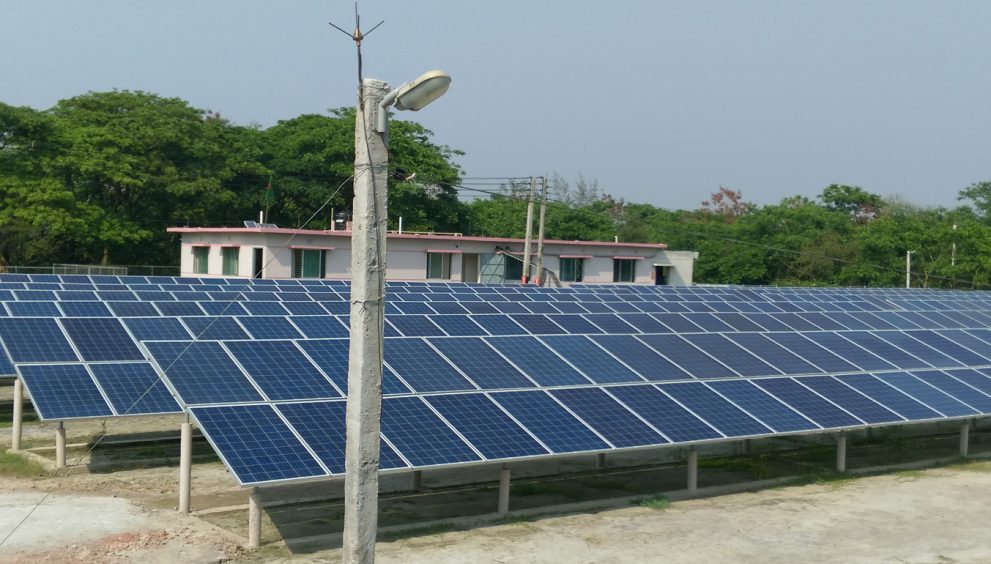
The 49.6-kilowatt-peak project in Chuadanga Sadar is cultivating green chillies beneath and around the solar installation, with rice and other seasonal vegetables planned for future cycles. Researchers will track crop yields, electricity generation, and system performance to determine whether the model can be expanded.
The Power Division is implementing the pilot through the Green Energy Transition – Policy Advisory Partnership, co-funded by the European Union and Germany’s Federal Ministry for Economic Cooperation and Development. GIZ Bangladesh is working with the government, and Germany’s Fraunhofer Institute for Solar Energy Systems is providing modelling, design, installation and research support.
Infrastructure Development Company Limited financed 80 per cent of the installation cost through a capital grant from Germany’s KfW Development Bank. WAVE Foundation sponsored the project and provided the site for a solar-irrigation facility. The irrigation system serves farming across roughly 50 acres, while surplus electricity can be supplied to the grid.
Agrivoltaics attempts to solve a difficult equation for Bangladesh. Solar power needs space, but agricultural land is scarce, intensively used, and central to rural livelihoods. Conventional solar parks can create conflict when landowners, tenant farmers and agricultural workers lose access to productive fields. The dual-use model seeks to generate electricity while keeping the land in cultivation.
Muhammad Khalequzzaman, joint secretary of the Efficiency and Conservation Division under the power and energy ministry, said dual use could help Bangladesh pursue sustainable-energy goals without compromising farm productivity and food security.
The argument is compelling, but the pilot’s value lies in testing it rather than assuming it. Panels change the amount and timing of sunlight, rainfall, wind, and evaporation reaching crops. Those changes can help some plants and harm others. Results depend on panel height and spacing, crop choice, season, soil, irrigation and farm practice.
Fraunhofer defines agrivoltaics as the simultaneous use of agricultural land for food and photovoltaic electricity. Its research has shown that dual use can improve total land productivity even where shade reduces the yield of particular crops. An early German trial found land-use efficiency increased by more than 60 per cent when agricultural output and electricity were considered together, although crop responses varied substantially.
Bangladesh cannot simply import that result. Chuadanga has different heat, humidity, monsoon rainfall, crops, labour costs and market conditions. The pilot must produce local evidence, including control plots grown without panel shade, if policymakers are to distinguish the effect of the system from ordinary variation in weather and farm management.
Crop selection will be critical. Green chillies may respond differently from rice, leafy vegetables or pulses. Shade can reduce heat and water stress for some crops, particularly during hot periods, but too little light can reduce photosynthesis and yield. Monsoon cloud cover may alter the balance further. Multiple seasons are needed before strong conclusions can be drawn.
Water is another part of the experiment. Panels can reduce evaporation and change how rain reaches the soil. Runoff from panel edges may concentrate water in some areas while leaving others dry. Designers need drainage that prevents erosion and waterlogging and irrigation that reflects the new moisture pattern. Measuring water use per kilogram of crop would show whether the system improves climate resilience as well as land use.
The design must also work for farmers. Elevated structures should allow people and machinery to move safely. Cables, foundations and low panel edges must not create hazards or block normal cultivation. Maintenance schedules should avoid damaging crops, while panel cleaning should not contaminate soil or compete for scarce irrigation water.
Before the inauguration, organisers trained farmers, teachers, researchers, engineering and construction professionals and system operators in shade-tolerant agriculture, maintenance and digital data collection. That local capacity is important because a system that depends permanently on foreign specialists will be difficult to scale.
The business model is as important as the engineering. Agrivoltaics costs more than placing panels close to the ground because structures may need to be higher, stronger and more widely spaced. The project must show who pays the extra cost, who owns the electricity, who receives land rent or revenue and how benefits are shared with farmers and labourers.
Land rights need particular care. A landowner may sign a solar contract while tenant farmers, sharecroppers or seasonal workers bear the disruption. National guidelines should require identification of all land users, informed participation, compensation where needed and protection of continued agricultural use. Calling a project dual-use does not guarantee that farming remains economically meaningful.
The electricity side also faces familiar challenges. Grid connection must be reliable, meters must record exports accurately and the tariff must support operation and repayment. If surplus power is curtailed or payments are delayed, the integrated farm could lose a central revenue stream. Storage or flexible agricultural loads may eventually help use more power on site.
The Chuadanga pilot builds on Bangladesh’s experience with solar irrigation. IDCOL has financed more than a thousand solar irrigation pumps, allowing farmers to replace diesel and reduce operating costs. Agrivoltaics can add a second use to the land around or beneath those systems, but retrofitting existing sites will require individual assessment.
Scaling should wait for evidence on both benefits and trade-offs. Policymakers need data on crop yield, electricity output, water demand, labour hours, installation cost, maintenance, farm income and land-equivalent ratio. Results should be published in an open format so universities and independent researchers can test the conclusions.
Environmental safeguards should include soil health, pesticide use, drainage, glare, biodiversity and end-of-life management for panels and electrical equipment. A climate solution should not transfer costs to farmers or leave damaged land and unmanaged waste after the contract ends.
Bangladesh formed a National Working Group on Agrivoltaics and Floating Solar in November 2025 to coordinate policy, research and investment. The Chuadanga data can give that group an empirical foundation for technical standards and approval rules. It can also help banks decide whether an agrivoltaic project has reliable cash flows and acceptable risk.
The country has set a target for renewable sources to meet 20 per cent of electricity demand by 2030. Conventional rooftops, utility-scale solar, wind and efficiency will all be needed. Agrivoltaics will not replace those options, but it could open a pathway where land conflict has slowed solar development.
The most useful outcome from Chuadanga is not a ceremonial claim that food and power always coexist. It is a clear record of when the combination works, which crops benefit, what it costs, and who gains. If the pilot answers those questions honestly across several seasons, Bangladesh will have more than a demonstration. It will have a basis for deciding where a dual harvest is genuinely possible.