
Bangladesh can make youth participation in climate diplomacy credible by combining technical skill, lived experience and transparent public selection.
As Bangladesh prepares its national position for COP31 in Antalya, to be held from 9 to 20 November 2026, the environment ministry has reportedly invited youth-organisation representatives into the drafting process. That is a welcome change. Young people are too often asked to applaud climate policy after it has been written, or to speak at side events while the consequential language is negotiated elsewhere.
Opening the drafting room is different. It gives young participants a chance to question assumptions, bring evidence from affected communities and help shape what Bangladesh seeks on adaptation finance, loss and damage, technology, mitigation and a just transition. Yet the value of that opening will depend on what comes next. If participation rests on personal networks or a small circle of familiar organisations, a promising reform could harden into another gatekeeping system.
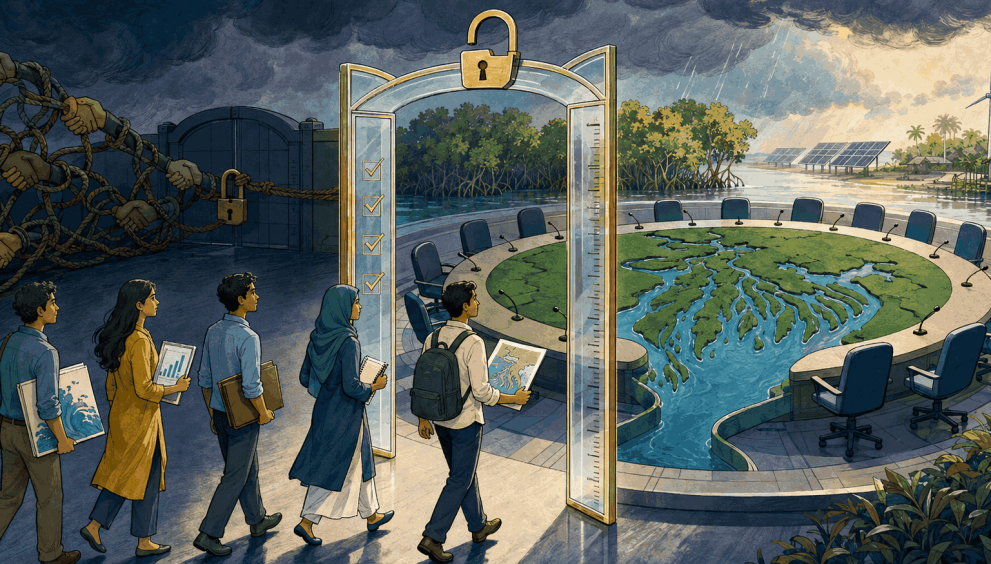
Bangladesh should use this moment to build something more durable: a National Pool of Young Climate Experts, recruited through a public process and available to support the government before, during and after each UN climate summit.
The promise is already in national policy
This proposal would not create a new obligation from nothing. Bangladesh’s NDC 3.0, submitted to the UN climate secretariat in September 2025, says more than half the country’s population is under 35. It promises meaningful participation by children and young people in implementation, monitoring and evaluation, and calls for stronger institutional platforms that bring youth voices into climate-policy dialogue and decision-making.
The document goes further than broad aspiration. It includes youth representatives in the national measurement, reporting and verification advisory structure and in each thematic working group. It also records a dedicated consultation with experts, youth activists and young people from across Bangladesh. The architecture, at least on paper, is beginning to emerge.
Young people have also shown that they can produce concrete proposals. In September 2025, a youth-led coalition handed the environment adviser 14 recommendations covering energy, agriculture, forestry and urbanisation. The process involved universities, development partners and the ministry. Bangladesh does not need to search for enthusiasm. It needs a system that can identify expertise beyond the most visible organisations and convert that expertise into policy.
Merit cannot mean privilege
A national pool should be merit-based, but that phrase must be defined with care. Climate negotiations are technically demanding. Bangladesh needs young people who understand science, economics, finance, law, diplomacy and sectoral policy. It also needs people who can read a draft quickly, identify weak evidence, write a defensible recommendation and work across disagreement.
But qualifications alone do not capture the knowledge Bangladesh requires. A young researcher modelling coastal adaptation and a community organiser documenting saline-water intrusion may understand different parts of the same problem. A disability-rights advocate can identify barriers that a technically sound evacuation plan overlooks. A farmer from a drought-prone district may expose assumptions hidden in a national agriculture strategy. Lived experience does not replace technical skill; it makes technical skill more relevant.
The risk is that ‘merit’ becomes shorthand for elite degrees, fluent English, Dhaka-based visibility or proximity to officials. That would exclude talented applicants from coastal districts, chars, haor areas, hill communities, tea-garden settlements and low-income urban neighbourhoods. It would also make the process less representative of the climate risks Bangladesh presents on the international stage.
The UN Youth Office’s guidance on meaningful participation offers a better standard. It says young people should be involved from design and planning through implementation, monitoring and evaluation, with sustained engagement, accountability and feedback. It also warns against tokenism and ‘youth washing’. The office’s core principles add that participation should be meaningful, representative, inclusive and safe. In other words, fair access and serious competence are not competing goals. A credible institution needs both.
Publish the rules before choosing the people
The ministry should begin with an annual call in Bangla and English, issued through universities, local government, civil-society networks and public digital channels. Applications should be accessible to persons with disabilities and should not require expensive certificates or organisational endorsements that add little evidence of ability.
Applicants could select technical tracks: adaptation, loss and damage, climate finance, mitigation, technology, agriculture and food systems, water, climate law, or gender and social inclusion. They should submit a short policy exercise and evidence of research, professional practice or community work. The ministry should publish the scoring rubric in advance, including the weight given to technical knowledge, writing, collaboration, relevant experience and public-service integrity.
A mixed selection panel should include ministry officials, experienced negotiators, academics and civil-society specialists. Panel members should declare conflicts of interest and recuse themselves where necessary. The ministry should publish the shortlist, the criteria and aggregate scores, followed by a short window for correcting factual or procedural errors.
International practice shows how competence and inclusion can be combined. The UNFCCC’s Climate Policy Innovators Youth Camp for Asia and the Pacific uses an open application and considers prior climate-policy engagement, while giving priority to rural, low-income, Indigenous and other underrepresented applicants. Bangladesh can design its own safeguards for geographic diversity, gender balance, disability inclusion and communities facing acute climate exposure.
Two routes into the pool would make it stronger. A technical cohort could support immediate drafting and analysis. An associate cohort could receive training, mentorship and supervised assignments, then compete for advanced roles in later cycles. Without such a pathway, the system will repeatedly select people who already have international exposure and deny newcomers the experience needed to qualify.
A seat is meaningful only when it carries influence
Selected members need a written mandate. It should specify which drafts they may review, what meetings they can attend, how they submit recommendations, and how confidential information is handled. Documents must arrive early enough for analysis, not hours before approval. Interpretation, accessible formats and reasonable domestic travel costs should be provided so that participation does not depend on personal income.
The ministry should also close the feedback loop. After finalising the national position, it could publish a simple response matrix showing which youth recommendations were accepted, revised or rejected and the reasons for each decision. This would not require the government to accept every proposal. It would require officials to demonstrate that participation was real.
Membership in the advisory pool should not automatically mean a COP badge or foreign travel. Official delegation roles require a separate assessment of negotiating responsibilities, budget and accreditation. Keeping those decisions distinct would reduce competition for visibility and ensure that the pool is valued for its policy work, not merely as a route to a conference.
The wider UN climate system offers useful models. YOUNGO, the official children and youth constituency, provides technical and policy input to negotiations, makes formal statements and engages decision-makers. Action for Climate Empowerment, rooted in the Climate Convention and the Paris Agreement, links participation with education, training and access to information. The Presidency Youth Climate Champion, institutionalised at COP28, is designed to strengthen inclusive youth engagement. These mechanisms differ, but they share a central lesson: access works best when it is backed by capacity, continuity and a clear institutional role.
Build an institution that can outlast a political moment
The original argument for youth inclusion uses words such as patriotism, objectivity and meritocracy. The intention is understandable, but those terms are too vague to carry a fair selection system. No participant is perfectly objective, and loyalty tests can silence necessary criticism. The ministry should instead assess evidence, competence, integrity, independence of judgement, disclosure of conflicts and commitment to the public interest.
Terms should be limited and staggered, allowing experienced members to mentor new entrants while preventing the pool from becoming a permanent club. A public annual report should record who served, what training was provided, which policy processes received input and how recommendations were used. Personal data can be protected while institutional performance remains visible.
Bangladesh has an opportunity to turn a welcome invitation into public infrastructure for climate diplomacy. An open and accountable national pool would draw on the country’s scientific talent, policy expertise and frontline experience. It would help negotiators arrive better prepared and help young people see that participation is earned through clear standards rather than personal access.
For a climate-vulnerable country, the credibility of the national position matters. So does the credibility of the process that produces it. Bangladesh can strengthen both by making youth participation open enough to discover talent, rigorous enough to improve policy, and inclusive enough to reflect the people whose future is being negotiated.
This opinion was written by Jubayer Islam, Executive Director, Climate Frontier.
Disclaimer: The views and opinions expressed in this article are those of the author and do not necessarily reflect the opinions and views of Renew Earth News.