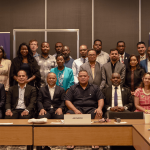


Santa Marta, Colombia- France has announced a comprehensive national roadmap to transition away from fossil fuels, marking one of the clearest policy signals yet from a major economy on how it plans to phase out coal, oil, and gas across its economy.
The roadmap was presented at the Santa Marta conference on transitioning away from fossil fuels, where French officials outlined both domestic targets and international commitments, including plans to support global energy transition efforts through climate finance and cooperation.
Benoît Faraco, France’s Special Envoy for Climate Negotiations, introduced the roadmap during the opening plenary session, describing it as a key national priority.
“We are also very proud to be one of the first countries to publish a domestic roadmap to transition away from fossil fuel,” Faraco said. “It was a top priority for my Minister to prepare it and to present it here in Santa Marta.”
A clearer pathway beyond “decarbonisation”
The roadmap consolidates France’s existing energy and climate policies into a single framework, offering a more transparent and structured plan for phasing out fossil fuels across sectors such as power, transport, and industry.
Climate policy experts say the move reflects a broader shift in global climate strategy—from general commitments to reduce emissions toward explicit timelines for ending fossil fuel use.
Leo Roberts, Acting Associate Director for Energy Transition, described the roadmap as a response to growing international expectations following recent global climate negotiations.
“France has fully understood the assignment from COP30 and Santa Marta—to set out in a clear, accessible, public document how they intend to phase fossil fuels out of all segments of the economy,” he said.
Roberts noted that while a full assessment of the roadmap’s ambition will require detailed analysis, the significance lies in its clarity and openness.
“A major economy signalling its fossil fuel phaseout plans so openly reinforces the sense that countries see the energy transition as both inevitable and beneficial if managed early and well,” he added.
Linking national policy with global responsibility
Beyond domestic measures, the roadmap also highlights France’s role in supporting international climate action, particularly through climate finance and engagement in global processes such as the UN climate negotiations.
Cat Abreu, Director of the International Climate Politics Hub, said the document sends a strong signal to other countries.
“It’s a big moment to have the world’s first national roadmap to transition away from fossil fuels,” she said. “This document is more than the sum of its parts—it brings together existing policies into a clear direction of travel and shows that other countries can do the same.”
She added that integrating the roadmap into France’s next Nationally Determined Contribution (NDC) under the Paris Agreement would be a crucial next step.
Economic and geopolitical framing
Advocates also pointed to the strategic framing of the roadmap, which positions fossil fuel phaseout not only as a climate necessity but also as an economic and security priority.
Andreas Sieber, head of political strategy at 350.org, said France has moved beyond vague language to adopt a more direct approach.
“France has officially moved past vague ‘decarbonization’ to embrace an explicit fossil fuel exit strategy,” he said. “By directly targeting coal, oil, and gas with clear end-dates, they are sending the message that phasing out fossil fuels is fundamentally a matter of national security and economic survival.”
He added that the roadmap reflects growing concerns over energy sovereignty, geopolitical risks, and inflation linked to fossil fuel dependence.
Questions over ambition and implementation
Despite broad praise, analysts cautioned that the effectiveness of the roadmap will depend on how it is implemented, particularly in light of recent concerns over France’s climate performance.
Anne Bringault, director of advocacy at Réseau Action Climat France, noted that emissions reductions have lagged behind targets in recent years.
“After two years of setbacks in its ecological transition policies, and with a pace of emissions reduction three times lower than its own targets since 2024, France deserves credit for setting fossil fuel phase-out dates,” she said.
However, she stressed that credibility will hinge on the resources allocated to ensure a just transition.
“The strong emphasis on electrification is a necessary lever, but it is not sufficient,” Bringault said. “It will need to be complemented by energy-saving policies such as high-performance building renovation and the development of alternatives to private cars, while ensuring support for vulnerable households.”
A signal to the global transition
France’s announcement comes at a time when countries are under increasing pressure to move from long-term climate pledges to concrete implementation plans.
The Santa Marta conference has emerged as a key platform for advancing discussions on fossil fuel phaseout, building on momentum from recent global climate summits.
While the French roadmap’s full impact will depend on policy follow-through and international uptake, experts agree that it represents a notable shift in how major economies are approaching the energy transition.
By setting out a detailed national pathway—and linking it to global cooperation—France is positioning itself at the forefront of efforts to define what a managed exit from fossil fuels could look like in practice.