

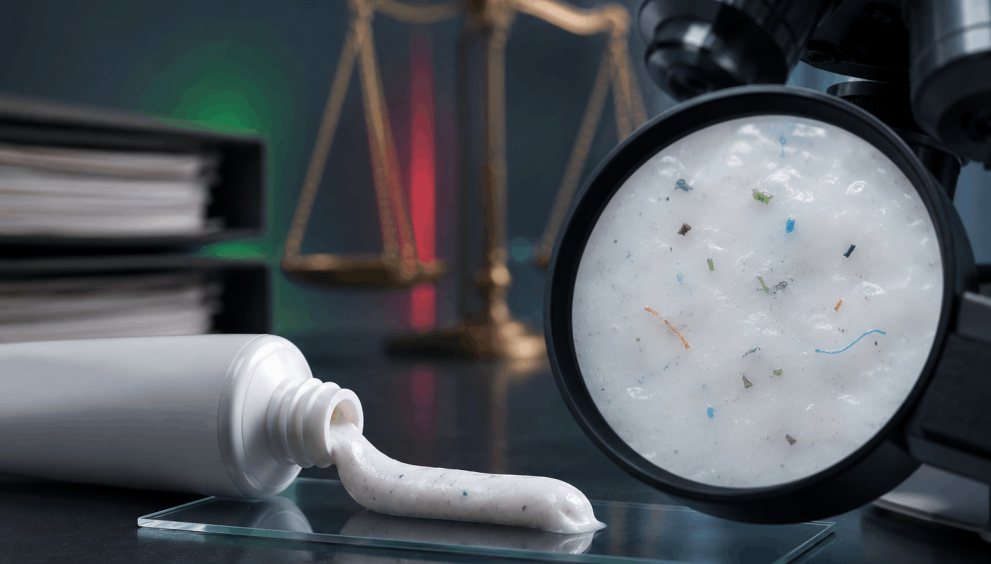
A High Court inquiry into alleged plastic particles in popular toothpastes tests whether Bangladesh can turn a disputed laboratory finding into transparent consumer protection.
Bangladesh’s High Court has ordered an expert inquiry after a study reported microplastics in most toothpaste samples it tested, placing scientific verification, product standards and public communication under intense scrutiny.
A bench of Justice Khizir Ahmed Choudhury and Justice Md Ziaul Haque ordered the formation of a three-member committee with one representative each from Bangladesh University of Engineering and Technology, Bangladesh Council of Scientific and Industrial Research and Bangladesh Standards and Testing Institution.
The court directed the committee to test whether microplastics were present and submit a report within 15 days. It ordered the health secretary and BSTI director general to comply after Supreme Court lawyer Md Abdullah Al Mamun filed a writ petition seeking action.
The case followed a study by the Environment and Social Development Organization. ESDO said it collected 34 toothpaste samples covering 19 brands between July 2025 and June 2026 and detected microplastics in 26 samples, or 76.5 per cent. It reported concentrations ranging from 20 to 320 particles per 100 grams.
Among the samples that tested positive, the organisation said 22 of 25 locally manufactured products contained particles. Its imported samples included one of five products from India, one of two from Thailand and both products tested from Vietnam. Four of six children’s toothpaste samples were positive, with a reported range of 20 to 140 particles per 100 grams.
The researchers said the samples were examined through stereomicroscopy and Fourier-transform infrared spectroscopy at Jahangirnagar University’s Environmental Health and Engineering laboratory. FTIR can help identify the chemical signature of a particle, but the court-appointed committee will need the complete sampling and analytical record to reproduce the results.
Independent confirmation matters because microplastics are technically difficult to measure. Plastic fibres and fragments are common in indoor air, clothing and laboratory equipment. Studies need clean containers, procedural blanks, contamination controls, documented batch numbers and clear rules for identifying a particle. A headline percentage alone cannot show whether the findings are representative of every product on the market.
The expert panel should test unopened samples from multiple batches, purchased through a documented chain of custody from different locations. It should report particle size, shape, colour and polymer type, along with detection limits and quality-control results. The final report should explain the method in language that another laboratory can repeat.
Microplastics are generally described as plastic particles smaller than five millimetres. In a personal-care product, they can arise from intentionally added polymer materials, contaminated ingredients, packaging, manufacturing equipment or the laboratory environment. Determining the source is essential because each pathway requires a different regulatory response.
Bangladesh does not have a specific limit or dedicated test standard for microplastics in toothpaste. BSTI can assess whether products meet existing safety, composition and labelling requirements, but the case shows a gap between traditional product standards and an emerging pollutant that may not fit older rules.
The health evidence should be communicated carefully. Scientists have detected microplastics in the environment and in human tissues, and research into exposure and potential harm is expanding. Yet the presence of particles in a sample does not by itself establish the dose absorbed by a toothpaste user or prove a particular disease. Regulators should avoid both false reassurance and unsupported alarm.
Oral exposure is only one concern. Toothpaste is rinsed into household wastewater, which can carry small particles through drains and treatment systems into rivers and sediments. Bangladesh has limited sewage treatment, so pollution released by millions of daily users could become an environmental issue even where individual health risk remains uncertain.
Companies named in reporting challenged or sought more information about the findings. Unilever said its products meet global and local standards and are safe and that it was seeking the study’s methodology and details. Square Toiletries said its products comply with regulatory requirements and undergo internal and third-party tests, adding that it would act if a problem were confirmed.
Those responses should be assessed against evidence, not reputation. Manufacturers should provide the committee with ingredient specifications, supplier audits, quality-control results and retained samples from the tested batches. Confidential commercial information can be protected while regulators publish the facts needed to establish consumer safety.
ESDO also surveyed 2,760 consumers nationwide. It said 42 per cent had never heard of microplastics and only 27 per cent considered themselves aware of the issue. That information gap creates fertile ground for rumours, particularly when social media reduces a technical study to a list of supposedly safe and unsafe brands.
The government should issue regular public updates while the inquiry proceeds. A useful notice would explain what is known, what remains under review and what consumers should do. People should not abandon oral hygiene on the basis of an unconfirmed online claim. They can continue brushing and follow any product-specific advice issued by health and standards authorities.
If the panel confirms contamination, regulators will still need to assess its cause and scale. A finding limited to one batch might require a targeted recall and correction at a factory. Evidence of an intentionally added plastic ingredient would support a wider restriction. Contamination across raw materials could require supplier controls and a broader market survey.
Bangladesh can learn from jurisdictions that have restricted plastic microbeads in rinse-off products, but the legal definition must be precise. A rule should specify particle size, polymer characteristics, product categories, exemptions and a phase-out period. It should not accidentally capture essential non-plastic ingredients or allow easily exploited loopholes.
Labelling is not a substitute for safety standards. Ingredient lists can help consumers make choices, but many polymer names are unfamiliar and a particle introduced through contamination will not appear on a label. Manufacturers remain responsible for controlling their production process and regulators for verifying compliance.
The inquiry also offers a chance to strengthen laboratory capacity. BSTI, BCSIR, universities and health agencies need validated methods, reference materials and trained analysts for microplastics in consumer goods, drinking water and wastewater. Shared protocols would make future findings more comparable and reduce disputes over methods.
Environmental monitoring should extend beyond toothpaste. Rivers receive plastic fragments from packaging, textiles, tyres and unmanaged waste. A narrow ban on a visible consumer product will have limited effect unless Bangladesh also improves waste collection, controls industrial discharge, expands wastewater treatment and reduces unnecessary plastic at source.
Accountability depends on publication. The court-ordered report should identify who selected samples, where they were bought, how they were stored, what controls were used and how particles were classified. Raw spectra and anonymised laboratory data should be available for peer review where possible.
The case is therefore larger than a dispute between campaigners and manufacturers. It is a test of whether an emerging environmental concern can move through a credible process: an initial finding, independent verification, proportionate enforcement and clear communication. A transparent result will protect consumers whether the study is confirmed, narrowed or rejected.