
Supporters say the 42.5MW Aminbazar plant will reduce landfill pressure, while campaigners warn its tariff, waste guarantee, emissions and ash could lock Dhaka into costly incineration.
A proposed 42.5-megawatt waste-to-energy plant on Dhaka’s edge is facing renewed calls for cancellation after environmental groups warned that its electricity price, capacity payments and pollution risks could burden the public for 25 years.
The North Dhaka project is planned beside the Aminbazar landfill and is designed to burn 3,000 tonnes of municipal waste a day. It would include four 750-tonne-per-day incineration lines, two 35MW turbo-generator sets and a six-kilometre transmission line to the Savar substation.
Project sponsors and lenders present the plant as a response to two urban problems: Dhaka’s growing waste stream and the limited space remaining at landfill sites. The New Development Bank says the facility would reduce environmental pollution from waste disposal and contribute electricity to the national grid. The Asian Infrastructure Investment Bank lists the estimated project cost at about $467 million.
China Machinery Engineering Corporation was selected after negotiations with the government, Dhaka North City Corporation and Bangladesh Power Development Board. The main implementation, power-purchase, waste-supply, and land-use agreements were signed in late 2021. BPDB would buy the electricity, and DNCC would supply the waste and land.
The Bangladesh Working Group on Ecology and Development disputes the economic and environmental case. In an appeal to the prime minister, the network said the project was approved under a special law without competitive bidding and that construction had still not begun more than four and a half years after the agreements.
BWGED said the power-purchase agreement sets a tariff of 21.78 US cents per kilowatt-hour, equivalent to about Tk26.79. At an 85 per cent plant load factor, the project would generate about 316.5 million units per year. The group said the tariff is roughly two and a half times recent solar prices and close to twice the cost it cited for coal power.
Its calculations show the cost rising sharply if the plant operates below the assumed level. At a 40 per cent load factor, BWGED estimated electricity at about Tk47 per unit. At 20 per cent, it said the cost could exceed Tk75. Those are advocacy estimates and should be tested against the full contract, financing terms, and verified waste characteristics.
The group also estimated an annual capacity-payment obligation of $58.87 million, or about Tk7.24 billion. Capacity payments compensate a plant for being available, whether or not all of its electricity is used. They can protect investors, but they shift demand and performance risk towards public agencies if the contract is poorly balanced.
The project company and authorities should publish the complete tariff formula, capacity-payment conditions, indexation, guaranteed output, commissioning schedule and termination provisions. Without those documents, the public cannot independently verify either the promoters’ claims or the opponents’ calculations.
Waste supply is a second point of contention. The plant requires 3,000 tonnes every day, and DNCC is responsible for delivering it. BWGED says the contract includes a per-tonne penalty for shortfalls. If the city’s recoverable waste is below the guarantee, the corporation could face pressure to divert material from recycling or pay for waste it cannot supply.
That risk goes to the centre of modern waste policy. Prevention, reuse, recycling and composting generally sit above energy recovery in the waste hierarchy because they conserve more material value. An incinerator built around a fixed daily feed can create a long-term demand for burnable waste, including plastic and paper that might otherwise be recovered.
Dhaka also has a large organic fraction in its municipal waste. Food and other wet material contain moisture and can have a low heating value. Incineration performs best when the feed is sufficiently dry and combustible. A plant may need careful sorting, pre-treatment or supplementary fuel if waste quality falls below design assumptions.
Supporters argue that engineered incineration with pollution controls is safer than uncontrolled landfill fires, open dumping and methane emissions. The project can also reduce waste volume substantially and recover electricity from material that cannot be reused. Those benefits are possible, but they depend on source separation, reliable operation, strict emissions controls and safe handling of residues.
BWGED estimated that the plant would release about 411,392 tonnes of carbon-dioxide equivalent a year and produce 73,576 tonnes of bottom ash, fly ash and particulate material. It also warned of heavy metals, dioxins, furans and acid gases. These figures come from the campaign group’s analysis and need comparison with the final environmental assessment, design guarantees and independent monitoring.
Incinerator ash does not disappear. Bottom ash may contain recoverable metal but still needs testing and controlled use or disposal. Fly ash and air-pollution-control residues can contain concentrated toxic substances and usually require hazardous-waste handling. Bangladesh must identify a licensed final destination before the plant operates, not after residues begin accumulating.
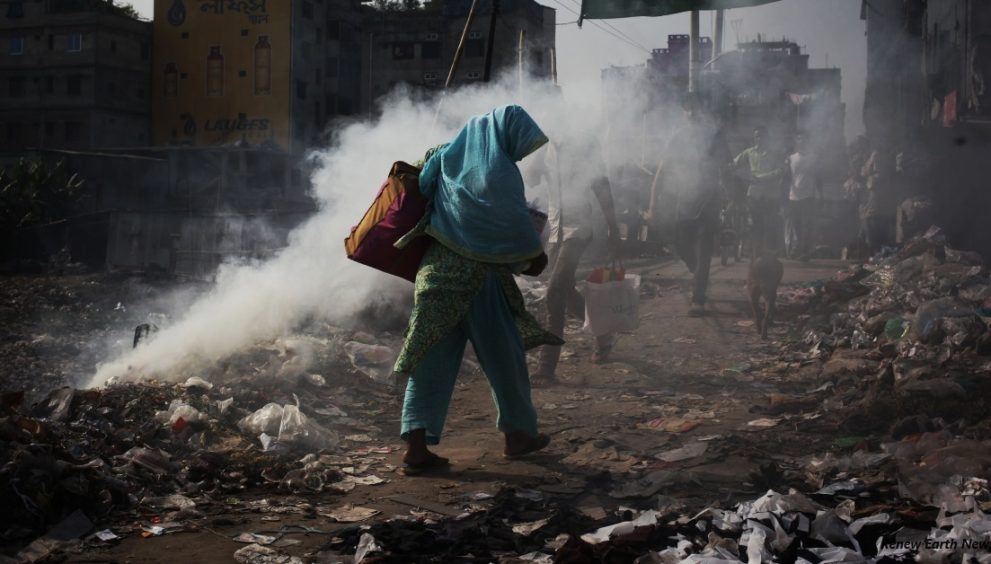
Air quality is especially sensitive around Dhaka, where residents already face heavy particulate pollution. Continuous emissions monitoring should cover particulate matter, nitrogen oxides, sulphur dioxide, carbon monoxide, hydrogen chloride, heavy metals, dioxins and furans. Raw and validated data should be published in near real time, with independent audits and automatic consequences for breaches.
The environmental assessment should also address cumulative exposure among landfill workers, waste pickers and nearby communities. Informal workers depend on recyclable material for income and may lose access if waste is redirected. A just transition requires registration, safe jobs, protective equipment, health screening and routes into formal sorting and recycling.
The project cannot be judged only as a power plant because its electricity would be small relative to the national system. Its larger function is waste management. The proper comparison is therefore not only cost per megawatt, but the full cost and benefit of alternative systems that combine collection, source separation, composting or anaerobic digestion, material recovery, engineered landfill and limited treatment of residual waste.
Organic waste could be separated for compost or biogas, while dry recyclables could support a formal recovery industry. Residual material with suitable heating value might then be treated at a smaller scale. Such a system requires household participation and municipal capacity, but so does an incinerator that needs a consistent 3,000-tonne daily feed.
Lenders classify the project as carrying high environmental and social risk. That status should trigger rigorous disclosure, consultation, grievance mechanisms, and monitoring. Residents need information in Bangla, including maps of the airshed, water pathways, transport routes, emergency plans and expected health safeguards.
Dhaka unquestionably needs a better waste system. Landfills are overloaded, collection is uneven, and uncollected waste blocks drains and contaminates water. The dispute is not between action and inaction. It is about whether this contract and technology are the safest and most affordable way to manage the city’s waste for the next quarter-century.
Before construction proceeds, the government should publish the agreements, update waste-composition studies, independently review financial assumptions, and compare the plant with lower-cost circular-economy options. If the project survives that test, its safeguards will be stronger. If it does not, cancellation would be less costly before billions of taka are locked in.